
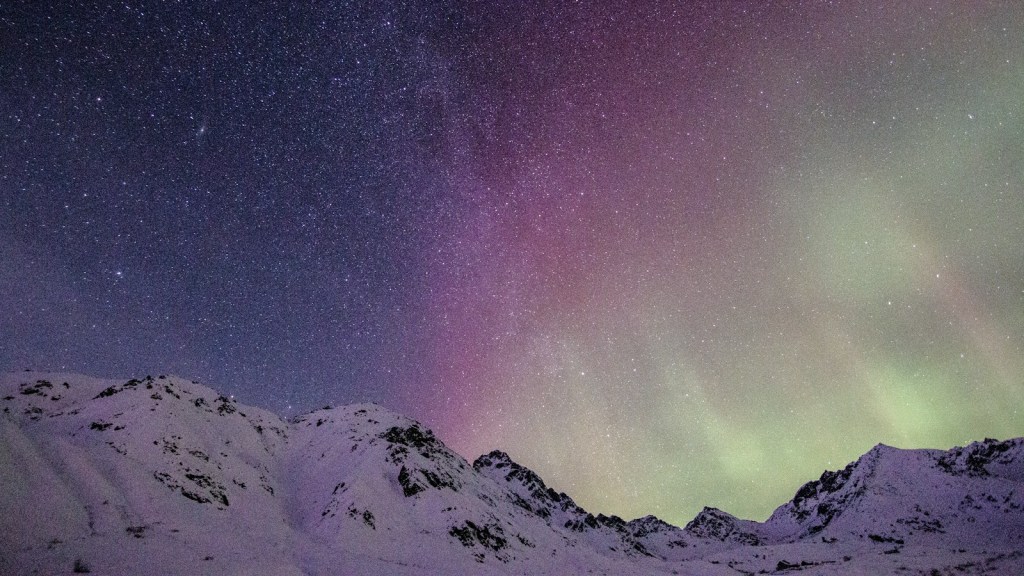
Alaska in winter is darker, colder and more welcoming than most visitors expect. In Anchorage, the largest city in the state, the shortest day of the year brings only about five and a half hours of daylight, yet the city fills with festivals, sled dogs, skiing and, on clear nights, the northern lights. This guide walks through Anchorage Alaska weather month by month, from November to March, with the temperatures, snowfall and daylight you can expect, then covers winter things to do in Anchorage and the best time to visit Alaska.
Anchorage Alaska winter weather at a glance
The figures below are the official 1991 to 2020 climate normals for Anchorage, recorded at Ted Stevens Anchorage International Airport. Temperatures are shown in degrees Fahrenheit, with degrees Celsius in parentheses, and snowfall in inches, with centimeters in parentheses.
| Month | Average high | Average low | Average snowfall |
|---|---|---|---|
| November | 29°F (−2°C) | 18°F (−8°C) | 12.6 in (32 cm) |
| December | 25°F (−4°C) | 14°F (−10°C) | 18.2 in (46 cm) |
| January | 23°F (−5°C) | 11°F (−12°C) | 12.4 in (31 cm) |
| February | 27°F (−3°C) | 15°F (−9°C) | 13.4 in (34 cm) |
| March | 33°F (1°C) | 19°F (−7°C) | 11.0 in (28 cm) |
Alaska in November: winter arrives for real
November is when the Anchorage Alaska winter settles in. The average high is about 29°F (−2°C) and the average low is about 18°F (−8°C). Roughly a foot of snow falls on average, about 12.6 inches (32 centimeters). The number that surprises visitors most is the light: each day is noticeably shorter than the last as the city heads toward the winter solstice.
Alaska in December: the darkest and snowiest month
December is both the darkest and the snowiest month of the year in Anchorage. About 18.2 inches (46 centimeters) of snow falls on average, and the average high is about 25°F (−4°C). On the winter solstice, December 21, the city receives only about five and a half hours of daylight, with sunrise around 10:15 in the morning and sunset shortly before 4 in the afternoon. Many residents drive to work in the dark and drive home in the dark. The encouraging part is that the light begins returning the very next day.
January: the coldest month
January is the coldest month in Anchorage. The average high is about 23°F (−5°C) and the average low is about 11°F (−12°C). The lowest temperature ever recorded in the city was −34°F (−37°C), on January 5, 1975. Even so, the days are already growing: daylight rises from roughly five and three-quarter hours on January 1 to nearly eight hours by the end of the month.
February: milder, brighter and festival season
February is milder and brighter, with an average high of about 27°F (−3°C) and about 13.4 inches (34 centimeters) of snow. It is also festival season. Late in the month, Anchorage hosts Fur Rondy, short for Fur Rendezvous, a winter festival that runs for about twelve days from late February into early March. Its events include snow sculptures, a parade and the Running of the Reindeer, in which crowds run down a snowy downtown street alongside reindeer.
March: winter starts to loosen its grip
By March the average high climbs to about 33°F (1°C), and daylight grows from about ten and a half hours on March 1 to about thirteen hours by the end of the month. Early in March, sled dog teams run an 11-mile ceremonial start of the Iditarod right through downtown Anchorage. The official restart takes place the next day in Willow, north of the city, and from there the teams head for Nome, on a trail of roughly 1,000 miles (about 1,600 kilometers).
Things to do in Anchorage, Alaska in winter
Winter does not close Anchorage down. If you are searching for things to do in Anchorage, Alaska between November and March, these are the main options:
- Festivals and the Iditarod start. Fur Rondy and the Iditarod ceremonial start both take place in downtown Anchorage, with events along 4th Avenue.
- Trails and skiing. The Tony Knowles Coastal Trail, reached from downtown, is a popular winter walk with views across Cook Inlet, and the Arctic Valley Ski Area offers skiing and snowboarding close to the city.
- Museums. The Anchorage Museum, the Alaska Native Heritage Center and the Alaska Aviation Museum are good indoor choices on the coldest days.
- Dog sledding and glacier outings. Guided dog sledding, glacier walks and glacier hikes are offered from Anchorage in winter.
- Northern lights tours. Guided aurora tours leave from the city on winter evenings.
The northern lights in Anchorage
The northern lights can be seen from mid-August through April, so the whole of the Anchorage Alaska winter falls inside the season. You need clear skies and a dark spot away from city lights, and viewing is never guaranteed, so plan to stay several nights.
Moose in the city
Roughly 300 to 350 moose spend the winter in and around Anchorage. Deep snow makes it hard for moose to travel and buries their food, so they move to flatter, plowed areas where they come into closer contact with people and cars. Wildlife biologists advise drivers to assume that a moose near the road may step into traffic, and to slow down.
Does Alaska have six months of darkness?
A common question is whether Alaska has six months of darkness in winter. In Anchorage the answer is no. Even on the shortest day of the year the city receives about five and a half hours of daylight, and the amount grows every day after the solstice, passing ten hours by March 1. Winter in Anchorage is dark, but it is never a polar night.
The best time to visit Alaska
For most travelers, the best time to visit Alaska is summer, roughly mid-May through mid-September, when the days are long and the full range of tours, cruises and wildlife viewing is available. Winter suits a different kind of trip. Visit in late February or early March if you want Fur Rondy and the Iditarod start, with daylight already near ten and a half hours and rising, or in December if you would rather experience the deepest part of the season. Dress in layers, plan for short days, and allow extra time for driving in snow.
Frequently asked questions
How cold is Anchorage, Alaska in winter?
Average highs run from about 23°F (−5°C) in January to about 33°F (1°C) in March, and average lows range from about 11°F (−12°C) in January to about 19°F (−7°C) in March. The coldest temperature ever recorded in Anchorage was −34°F (−37°C), on January 5, 1975.
What is the coldest month in Anchorage?
January, with an average high of about 23°F (−5°C) and an average low of about 11°F (−12°C).
How much daylight does Anchorage get in winter?
About five and a half hours on the winter solstice, December 21. Daylight reaches nearly eight hours by the end of January, about ten and a half hours on March 1 and about thirteen hours by the end of March.
How much snow does Anchorage get?
December is the snowiest month, with about 18.2 inches (46 centimeters) on average. November, January, February and March each average between about 11 and 13.4 inches (28 to 34 centimeters).
When can you see the northern lights in Alaska?
The northern lights season runs from mid-August through April, so every winter month falls inside it. You need clear skies and a dark location away from city lights.
What is Fur Rondy?
Fur Rondy, short for Fur Rendezvous, is Anchorage’s winter festival. It runs for about 12 days from late February into early March and includes the Running of the Reindeer.
How long is the Iditarod?
The Iditarod Trail Sled Dog Race covers about 1,000 miles (1,600 kilometers) to Nome. It begins with an 11-mile (18-kilometer) ceremonial start in Anchorage, and the race restarts in Willow the next day.
How many moose live in Anchorage?
Roughly 300 to 350 moose spend the winter in and around Anchorage.
What is the lowest temperature ever recorded in Anchorage?
The record low is −34°F (−37°C), recorded on January 5, 1975.
If you enjoy guides like this, see our best cities to visit in Italy in winter and our ranking of the best places in California to visit, browse more in our Travel section, and subscribe to Mr Global Rankss on YouTube for more of the world’s stories.
Original T-Shirt Designs
Wear what you believe in
Two original designs, each built on a single word of hope and peace.
Sources
- Wikipedia: Anchorage, Alaska (climate normals)
- Current Results: Anchorage average temperatures by month
- Current Results: Anchorage snowfall totals and averages
- Alaska Climate Research Center: Winter solstice daylight
- Alaska.org: Shortest day in Alaska
- Alaska.org: Anchorage daylight hours in January
- WeatherSpark: Average weather in January in Anchorage
- Alaska.org: Anchorage daylight hours in March
- WeatherSpark: Average weather in March in Anchorage
- National Weather Service: Temperature records for Anchorage, Alaska
- Current Results: Anchorage lowest temperature for each year
- Alaska’s News Source: Fur Rondy 2026
- Travel Alaska: Fur Rondy
- Alaska’s News Source: Running of the Reindeer
- Mushing.com: 18 things to know about the 2026 Iditarod
- Anchorage Daily News: Race start details for the Iditarod
- Alaska’s News Source: How many moose live in the Anchorage bowl
- FOX Weather: Snow forcing hungry moose into Alaska’s largest city
- Anchorage Daily News: Deep snow may lead to record moose deaths
- Visit Anchorage: See the northern lights in Anchorage
- Alaska.org: Northern lights trip ideas
- Historic Anchorage Hotel: Things to do in Anchorage in the winter
- Destinationless Travel: Things to do in Anchorage, Alaska in winter
- Alaska.org: Best time to visit Alaska
- AlaskaTravel.com: Best time to visit Alaska


Leave a Reply