
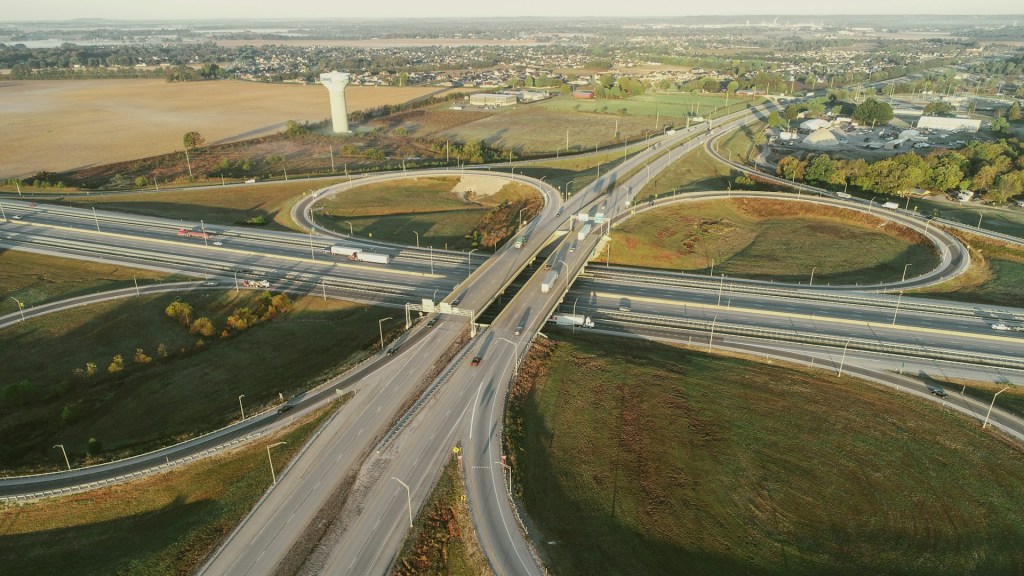
Highway exit ramps in the U.S. curve into a cloverleaf shape because the curve lets drivers turn left without crossing oncoming traffic and without stopping at a traffic signal. A cloverleaf interchange is the result: two highways cross at different levels, and four looping ramps handle the left turns. That is why a cloverleaf highway looks like a four-leaf clover from the air. This guide explains how a cloverleaf interchange works, where the first cloverleaf interchange was built, why cloverleaf interchanges are often called bad design today, and what is replacing them.
What is a cloverleaf interchange?
A cloverleaf interchange is a junction where two highways cross, one passing over the other, and drivers move between them entirely on connecting ramps. Nothing in the design requires a traffic light. Right turns use short, direct ramps. Left turns use the four loops that give the design its name. Strictly speaking, the curved shapes are not exit ramps alone but an interchange made of ramps, which engineers call loop ramps.
Why are the ramps curved? How a left turn works
The curve exists to solve one problem: a left turn normally means crossing the lanes of oncoming traffic. A cloverleaf avoids that by turning the movement inside out. A driver who wants to turn left first drives straight through, passes over or under the crossing road, and then exits to the right onto a one-way loop. Road-design references describe a loop ramp as one that serves left turns by circling 270 degrees to the right, and the loop then delivers the driver onto the other highway heading in the new direction. Every turn in the interchange is made without crossing another driver’s path at street level, which is why the design was seen as a major advance in keeping traffic moving.
Who invented the cloverleaf, and where was the first cloverleaf interchange?
Arthur Hale, a civil engineer from Maryland, received the first U.S. patent for the cloverleaf design on February 29, 1916. The first cloverleaf interchange built in the U.S. opened in 1929 in Woodbridge Township, New Jersey, where Route 25 met Route 4. Edward Delano, of the engineering firm Rudolph and Delano, designed it. As traffic grew, the original design became a problem, and in 2006 the New Jersey Department of Transportation demolished it and built a modified partial cloverleaf in its place. If you are searching for the first cloverleaf interchange, Woodbridge is the answer.
Why are cloverleaf interchanges bad?
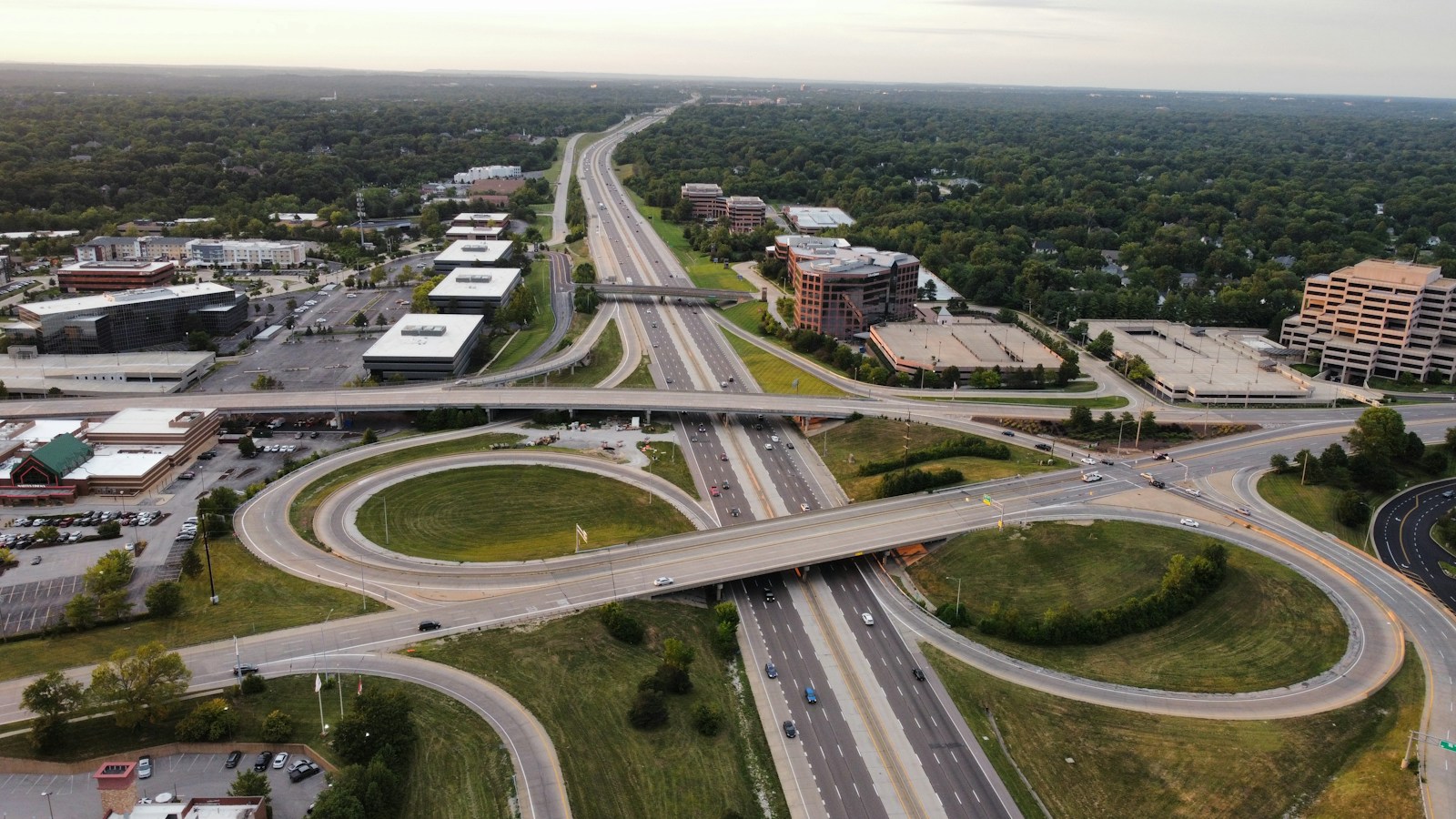
The main weakness is weaving. In a classic cloverleaf, the loop that brings cars onto a highway sits right beside the loop that takes cars off it, so drivers entering and drivers leaving must cross each other’s paths within a short stretch. Road engineers describe weaving as the limiting factor in a cloverleaf interchange’s capacity, and one highway-design reference calls it the primary reason cloverleafs are no longer chosen for new or rebuilt interchanges. It can cause bottlenecks and crashes, and the problem grows as traffic increases.
Land is the second problem. Loop ramps need a great deal of space, which was easy to find when land was cheap but became harder as property grew more expensive. A cloverleaf becomes a choice between tight turns and a lot of consumed land.
Highway interchange types: what replaces the cloverleaf?
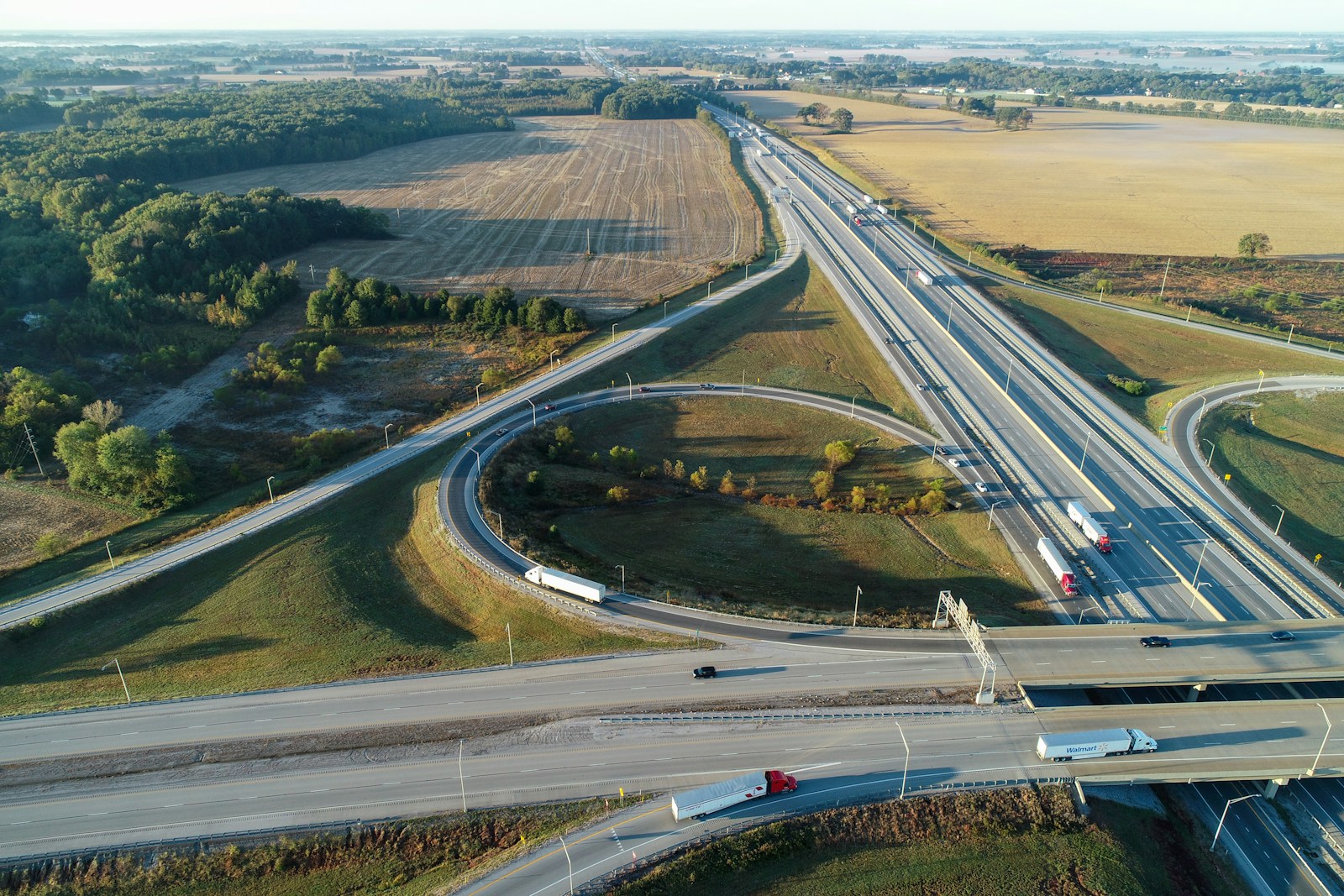
Many road agencies now replace full cloverleafs with designs that avoid weaving. The common highway interchange types used instead include:
- Partial cloverleaf (parclo). A partial cloverleaf interchange keeps some loop ramps and removes others. A design with only one, two or three loops is not called a true cloverleaf, and highway agencies, including in California, have been converting old full cloverleafs into partial ones. Woodbridge’s replacement is an example.
- Diamond and single-point urban interchange (SPUI). These designs, along with the partial cloverleaf, are classed as conventional by the Federal Highway Administration, and both are used to replace cloverleafs.
- Diverging diamond interchange. This newer design shifts traffic to the opposite side of the road briefly so left turns no longer cross oncoming traffic. The first one in the U.S. opened in 2009 at Interstate 44 and Kansas Expressway in Springfield, Missouri, at a cost of about $3 million.
The classic cloverleaf has not vanished. Engineers sometimes add a collector-distributor road beside the highway to move weaving off the main lanes, which keeps an existing cloverleaf working longer.
Frequently asked questions
What is a cloverleaf interchange?
It is a two-level junction where two highways cross and four loop ramps let drivers turn left without crossing traffic or stopping at a signal.
Where was the first cloverleaf interchange in the U.S.?
In Woodbridge Township, New Jersey, in 1929, at the junction of Route 25 and Route 4. It was demolished in 2006 and replaced with a modified partial cloverleaf.
Why are cloverleaf interchanges bad?
Weaving. Cars entering the highway from one loop and cars leaving it for the next loop must cross paths in a short space, which limits capacity and can cause crashes. The design also takes up a lot of land.
What is a partial cloverleaf interchange?
A cloverleaf with one, two or three loop ramps instead of four. Engineers often call it a parclo, and it is a common way to rebuild an old full cloverleaf.
How many degrees is a cloverleaf loop ramp?
A loop ramp circles 270 degrees to the right to complete a left turn.
If you enjoy explainers like this, browse more in our Facts section and subscribe to Mr Global Rankss on YouTube for more data driven stories.
Original T-Shirt Designs
Wear what you believe in
Two original designs, each built on a single word of hope and peace.
Sources
- Wikipedia: Cloverleaf interchange
- Historical Marker Database: Woodbridge Cloverleaf
- Transportation History: A pioneering development in highway design
- Kurumi: Field Guide to Interchanges, Cloverleaf
- Kurumi: Interchange glossary (loop ramp)
- Federal Highway Administration: Alternative intersections and interchanges (TechBrief FHWA-HRT-16-069)
- Equipment World: U.S. highways are shifting to alternative interchange designs
- Transportation awards: Diverging Diamond Springfield Interchange Project


Leave a Reply