
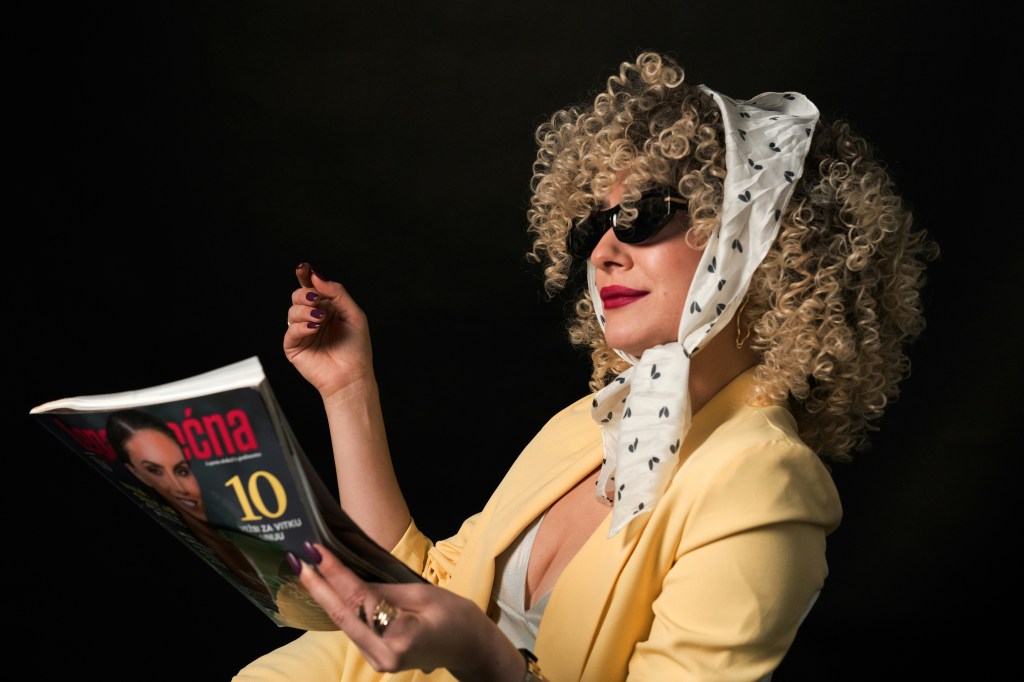
People in the 1980s styled their hair by combining chemistry, heat and volume-building products. Perms created lasting curls, teasing and blow-drying added height, mousse and gel shaped the result, and hairspray held it in place. Alongside this big, soft look, the Jheri curl and the hi-top fade became defining styles closely tied to Black music and culture, and the mullet spread widely, although the word itself is not documented for the haircut until 1994.
Key facts
- A perm works by breaking and rebuilding the disulfide bonds in hair, usually with ammonium thioglycolate followed by a neutralizer, so the curl lasts until the treated hair grows out.
- Heat tools such as curling irons and crimpers made only temporary shapes, because they act on the weaker hydrogen bonds in hair.
- Teasing, or backcombing, builds volume by combing a section of hair toward the scalp; the technique was already used for the bouffants of the early 1960s.
- U.S. agencies began phasing out CFC propellants in aerosols, hair sprays included, from October 15, 1978; makers moved to other gases or pump bottles.
- Styling mousse became a mass-market product in the mid-1980s, with L’Oréal among the leaders.
- The Pro-Line Curly Kit reached stores in 1980 at about $8 a box and brought the Jheri curl into the home.
- The hi-top fade is closely tied to early hip-hop; Big Daddy Kane and Kid ‘n Play are named as wearers.
- The earliest confirmed use of “mullet” for a haircut is the Beastie Boys’ 1994 song “Mullet Head”.
The 1980s are remembered for hair that took up space: tall bangs, tight perms, crimped waves, glossy curls and sharply faded tops. No single method produced all of it. The decade drew on salon chemistry, household appliances, new aerosol and foam products, and the influence of music and television. This article explains the main techniques, the products and tools behind them, and who is credited with popularizing each style, and it says plainly where the surviving evidence is thin.
How did people in the 80s do their hair?
Most styles of the decade were built in three layers. The first was shape, supplied by a cut or a perm. The second was volume, created by teasing, blow-drying and heated tools. The third was hold, provided by mousse, gel and hairspray. The student newspaper of the University of California, Los Angeles, looking back in 1998, said the decade brought back big hair and big bangs, which meant more teasing and a great deal more hairspray. Fashion-Era, a costume history site, adds that new mousse and gel products added volume, especially to flicks, the swept-up fringes that stayed fashionable as hair grew bigger.
Blow-drying was a routine step. Fashion-Era describes it as the favored finish for most women in the decade, and a barber interviewed by Marketplace lists a blow dryer alongside gel and mousse among the tools of a hi-top fade. The look also varied by community, so it is better to think of the 1980s as several overlapping styles than as one.
Why was 1980s hair so big, and how was the volume built?
The chemistry explains much of it. According to a science explainer on 1980s hair, each strand is held together by hydrogen bonds and by stronger disulfide bonds. Heat from curling irons breaks the weaker hydrogen bonds and creates temporary waves, crimps and curls, while perm solutions break the disulfide bonds so that the curls last. A university chemistry module on the permanent wave confirms the distinction: a temporary curl relies only on hydrogen bonds, which water disrupts, so it disappears when the hair is wet. A video summary shared by Laughing Squid, drawn from a chemistry-society video series, put the whole look down to a little teasing and a lot of chemistry.
What was teasing?
Teasing, also called backcombing, is the practice of combing a section of hair toward the scalp to build a dense cushion at the roots. A salon-products guide on the beehive instructs readers to hold the section taut and comb toward the scalp several times to create height. The method was not new in the 1980s: a fashion encyclopedia describes the bouffant of the 1950s and 1960s as hair rolled up, then backcombed to give it maximum height and fixed with lacquer spray. No source opened for this article documents a step-by-step routine used by ordinary people in the 1980s, so the description above rests on general styling references and on the decade’s heavy use of the same tools.
How did hair metal take it further?
Rock bands pushed the look to an extreme. A 2006 Associated Press feature carried by The Seattle Times, based on the writer Steven Blush’s book on the genre, described the scene as teased-out and heavily mascaraed and noted that the book opens with a photograph of a can of Aqua Net. A 2003 Christian Science Monitor article likewise recalled MTV promoting bands that relied on heavy use of Aqua Net.
What products and tools were behind the look?
Hairspray
Hairspray was the foundation of the hold. A regulatory change had, however, reshaped the product shortly before the decade began. In 1977 the Food and Drug Administration, the Environmental Protection Agency and the Consumer Product Safety Commission proposed a phase-out of chlorofluorocarbon propellants in aerosols, naming hair sprays among the affected products, because the chemicals can reduce the ozone layer. The EPA archive records that the restrictions began on October 15, 1978 and adds that many aerosol producers had already switched to other propellant gases or to mechanical pumps. Hairspray itself therefore continued; only its propellant changed.
Mousse and gel
Mousse, a foam that adds body without the stiffness of spray, belongs to the middle of the decade. A curly-hair product history says mousse first appeared in the mid-1980s with L’Oréal’s Free Hold, while a company history of its distributor Cosmair describes the preparations for Free Hold in 1983 and its success by 1985. A Vogue article reprinted by the Huffington Post names a different L’Oréal product, Studio Line mousse, launched in 1985, so the sources differ on the exact product name. They agree on the effect: the Vogue piece credits mousse with helping create big, gravity-defying hair.
Blow dryers and heat tools
The handheld dryer was not a 1980s invention. JSTOR Daily reports that handheld models became available in the 1920s, and Fashion-Era likewise dates portable electric dryers to the 1920s. In the 1980s the dryer sat beside curling irons and crimpers, which shaped hair only temporarily.
How did a perm work, and why were perms so common?
The permanent wave was invented by the hairdresser Karl Nessler, who also went by Charles. Time magazine, in his 1951 obituary, reported that he found hair soaked in an alkali solution and heated while curled would hold its curl, and a history of the perm describes his system as a combination of chemical and thermal processes.
The explainer on 1980s hair says perms of the era used ammonium thioglycolate, and the university module cited above sets out the three steps of the process: a reducing agent, typically ammonium thioglycolate, breaks some disulfide bonds; the hair is wound on rollers to set the new shape; and a neutralizer, usually dilute hydrogen peroxide, re-forms the bonds in their new positions. The curl then lasts until the treated hair grows out, since new growth is untreated.
Perms were prominent. Fashion-Era notes that early in the decade afro perms were worn by white people of both sexes and that long spiral perms were popular, and the UCLA student newspaper observed that the perm grew large in this period. Neither source gives a figure for how many people had one, and none of the sources opened for this article does, so the scale of the trend cannot be stated in numbers.
Hair care has always followed fashion in layers. For an earlier decade of long, natural hair, see how people had such long hair in the 70s.
What was the Jheri curl, and who made it popular?
The Jheri curl was a two-step chemical treatment that softened the hair and then set it into loose, glossy curls. The business newsletter The Hustle and History.com both credit the hair-care entrepreneur Jheri Redding with developing the process in the 1970s, and The Hustle and NPR describe the resulting style as aimed at the Black market. Its name comes from Redding’s.
The style reached a mass audience through a cheaper home version. Comer Cottrell, who founded the Pro-Line Corporation in 1970, introduced the Curly Kit. The Hustle and History.com place its arrival in stores in 1980 at about $8 a box, and NPR, in its 2014 obituary of Cottrell, gives the same price while noting that the salon version took hours and cost hundreds of dollars. The sources word the first-year sales slightly differently, as nearly $10 million and as over $10 million, so it is safest to say roughly $10 million.
All three accounts name Michael Jackson as a wearer; NPR also lists Eazy-E, Ice Cube and Rick James. Maintenance was demanding. The Hustle says the routine of reapplying glycerin-based gels stained collars and pillowcases, and The Root’s survey of Black hairstyles says the oily finish could wreck pillowcases and headrests. By the end of the decade the style had become a punchline, according to The Hustle.
One episode is often linked to the style’s decline, and accounts differ on it. In 1984 Jackson was burned during the filming of a Pepsi commercial. The Hustle says many blamed his Jheri curl, whereas a music news site reports that the flammable material was the pomade in his hair and does not mention a Jheri curl at all. Both agree that pyrotechnics set off the fire; the role of the hairstyle remains a matter of dispute rather than established fact.
What was the hi-top fade, and where did it come from?
The hi-top fade combined sides cut very close to the skin with a flat-topped column of hair rising straight up. Marketplace describes the sides faded close to the skin and the top staying flat and extending straight up, and History.com says Black barbershops had already perfected the fade and developed it further in the 1980s, when the birth of hip-hop strongly influenced style.
Marketplace ties the style to the hip-hop community and names Big Daddy Kane, Salt-N-Pepa and Will Smith as wearers. A 2017 Fox 5 New York report names Big Daddy Kane and Kid ‘n Play as the artists who gave the high-top its life. The performer Grace Jones is frequently associated with an earlier version: Fox 5 calls her the godmother of the look, and Woman & Home lists her high-top fade among the hairstyles that made history.
No source opened for this article identifies a single inventor or an exact date for the first hi-top fade, so the origin is best described as a collective development in barbershops and in early hip-hop. The same applies to the cut’s name, which appears in the sources as both hi-top and high-top.
Heat styling has a long history of its own, as shown in how people in the 1800s curled their hair.
Was the mullet really an 80s hairstyle?
The haircut was widespread by the 1980s, and History.com says it was popularized in that decade. The word is a different matter. Vocabulary.com, summarizing research by the Oxford English Dictionary, reports that the earliest confirmed use of “mullet” as a hairstyle name is the Beastie Boys’ 1994 song “Mullet Head”. History.com independently gives the same year and credit.
Vocabulary.com adds that the dictionary’s editors found no evidence that people called the haircut a mullet in the 1980s, and it quotes the editor Graeme Diamond as saying the haircut was fairly unremarkable at its peak and so did not need a name. That is consistent with the dictionary’s citation of the Beastie Boys as the first use.
As for the style’s ancestry, History.com describes David Bowie’s orange hair as part of his Ziggy Stardust persona in 1972, and Suzi Ronson’s account, reported by the Irish Examiner, says the brighter orange colour and the Ziggy style had fully arrived by St Patrick’s Day 1972. The word mullet was applied to the haircut only later.
Which famous people set the trends?
Television and music carried styles from salons to the public. The feathered look associated with Farrah Fawcett and the television series Charlie’s Angels rose in the 1970s. A salon-industry publication reports that the Beverly Hills hairdresser Allen Edwards blow-dried her hair with a round brush instead of using rollers, and an encyclopedia entry describes the finished style as held in place with plentiful gel and spray. Sources disagree on how long it lasted: the encyclopedia says it faded in the early 1980s, while Woman & Home calls it one of the defining looks of both the 1970s and the 1980s.
Diana, Princess of Wales, was the other major influence. The same publication names her stylists Kevin Shanley and Richard Dalton and describes a feathered early-1980s style, and The Zoe Report says she wore feathered hair with side-swept bangs for most of the decade, with Dalton as her stylist.
A short timeline of dates supported by at least two sources:
- 1970s: the feathered look spreads through the television series Charlie’s Angels.
- October 15, 1978: the phase-out of CFC propellants in aerosol products begins.
- 1980: the Pro-Line Curly Kit reaches stores.
- 1984: Michael Jackson is burned during a Pepsi commercial shoot.
- Mid-1980s: styling mousse becomes a mass-market product.
- 1994: the first confirmed printed use of “mullet” for a haircut.
Frequently asked questions
Which hairspray is most associated with 1980s hair?
Aqua Net is the brand named in accounts of 1980s big hair. The Christian Science Monitor and The Seattle Times both use it as shorthand for hair-metal styling, and the UCLA student newspaper uses it for teased 1980s hair generally.
Was hairspray banned in the 1980s?
No. Regulators phased out chlorofluorocarbon propellants from aerosols beginning in 1978, and the EPA notes that many producers had already switched to other gases or pumps. The 1977 federal announcement targeted the propellant, not the product.
How long did a perm last?
Until the treated hair grew out. A university chemistry module explains that new hair is untreated, and the science explainer on 1980s hair says perm chemistry breaks the stronger disulfide bonds so that curls last.
Who wore the hi-top fade?
Marketplace names Big Daddy Kane, Salt-N-Pepa and Will Smith, and Fox 5 New York names Big Daddy Kane and Kid ‘n Play. Marketplace ties the style to the hip-hop community.
When did people start calling it a mullet?
The earliest confirmed printed use for a haircut is the Beastie Boys’ 1994 song “Mullet Head,” according to Vocabulary.com and History.com. The haircut itself was common earlier.
Eighties hair was an ordinary mix of chemistry, heat and product, and each famous style carried its own history behind the spray.
Related reading: how people had such long hair in the 70s, how people in the 1800s curled their hair and how Victorians washed their hair.
Sources
- History.com: Mullet hair style, rebels and history
- Vocabulary.com: Think of mullet as a 1980s word? It's not
- The Hustle: The beauty entrepreneur who made the Jheri curl a sensation
- NPR Code Switch: Comer Cottrell, creator of the people's Jheri curl, dies at 82
- History.com: Black hairstyles, a visual history in photos
- The Root: Black hairstyles, this is how we 'do it
- Marketplace: Hi-top fade haircut, it's all business
- Fox 5 New York: After Empire, the high-top fade
- American Songwriter: Remember when Michael Jackson's hair catches on fire while filming commercial
- Earth.com: The science behind big 80s hair
- LibreTexts Chemistry: Permanent hair wave
- Laughing Squid: The chemistry behind the crimping, curling and styling products that made hair so very big in the 1980s
- The Seattle Times (AP): Teased, tousled and torrid, 80s mane men aimed high
- The Christian Science Monitor: Hair metal returns
- Daily Bruin: The hair and now
- Fashion-Era: 1980s hairstyles
- Fashion-Era: Hair dryer history
- JSTOR Daily: A short history of hairdryers
- Encyclopedia.com: Beehives and bouffants
- Hair.com: Beehive hair
- NaturallyCurly: From Dippity-Do to macromolecules
- Encyclopedia.com: Cosmair Inc. company history
- Vogue via HuffPost: Mousse is having a moment
- U.S. EPA archive: Government ban on fluorocarbon gases in aerosol products begins October 15, 1978
- U.S. Consumer Product Safety Commission: CPSC, FDA and EPA announce phase-out of chlorofluorocarbons
- American Salon: Princess Diana's style remembered
- The Zoe Report: Princess Diana's iconic hair and how it evolved
- Encyclopedia.com: Farrah Fawcett look
- American Salon: Ode to a beauty icon
- Woman & Home: Hairstyles that made history
- TIME: Modern living, the great wave (1951)
- Glamour Daze: A history of the perm hairstyle
- Irish Examiner: Suzi Ronson on the Bowie years and the Ziggy hairstyle


Leave a Reply