
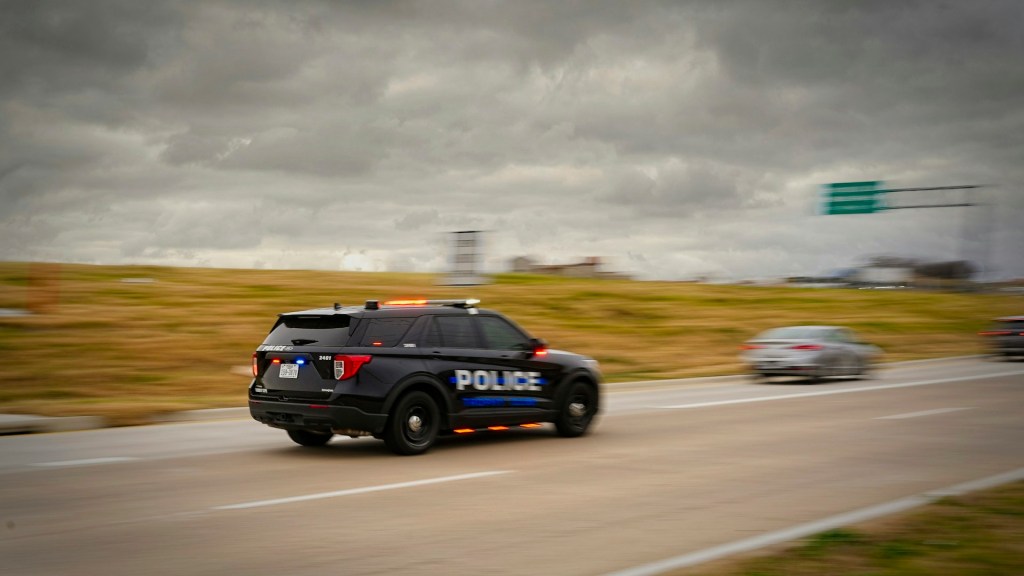
How do radar guns measure speed? A radar gun sends a beam of radio waves toward a moving object and listens for the echo that returns. Because the object’s motion changes the frequency of that echo, the gun can convert the shift into a speed reading within a small margin of error. That is the short answer to how do radar guns work, and it applies whether the gun is held by a police officer, mounted in a patrol car or pointed at a baseball pitcher. This article explains the Doppler effect, the radio bands that police radar uses, the angle problem known as cosine error, how radar differs from laser (lidar) guns, how baseball radar guns work, and where accuracy reaches its limits.
How do radar guns work? The Doppler effect explained
Every radar speed gun is a small Doppler radar, according to Wikipedia and Best Car Audio. The device transmits a narrow beam of radio-frequency energy and measures the signal that reflects back from the target. When the target is moving toward the gun, the returning waves arrive at a higher frequency than the waves that were sent. When the target is moving away, the returning waves arrive at a lower frequency.
A helpful way to picture this is a steady series of pulses thrown at a wall. If the wall rushes toward you, the pulses come back closer together; if it retreats, they come back farther apart. The gun does not need to time the echo. Instead, it compares the outgoing and returning signals. HyperPhysics and Wikipedia both explain that the two signals are mixed to produce a beat frequency, and The Physics Hypertextbook adds that the frequency shift is directly proportional to the velocity of the reflecting object. A faster vehicle therefore produces a larger shift, and the gun’s electronics turn that shift into the number on the display. According to Best Car Audio and Vortex Radar, the whole process takes well under a second.
Which radar bands do police speed guns use: X, K and Ka?
Police radar operates in the microwave part of the radio spectrum, and the bands are named by letter. Wikipedia and Best Car Audio both describe X band as roughly 8 to 12 GHz, K band as roughly 18 to 27 GHz and Ka band as roughly 27 to 40 GHz. In practice, each band is used at a much narrower spot. The Physics Hypertextbook and Cobra’s enforcement guide place X band near 10.5 GHz and K band near 24 GHz. Cobra lists Ka band at about 33.6 to 36.0 GHz, and Vortex Radar gives a similar range of about 33 to 36 GHz.
X band is the oldest of the three and is now less common, according to Wikipedia and Cobra, which says it is no longer in widespread use. Ka band is the busiest band for police radar in the United States today, according to Vortex Radar, and Cobra likewise calls it the most active band that drivers face. Older X-band equipment is also prone to interference, since Wikipedia and Best Car Audio both note that automatic door openers use similar frequencies.
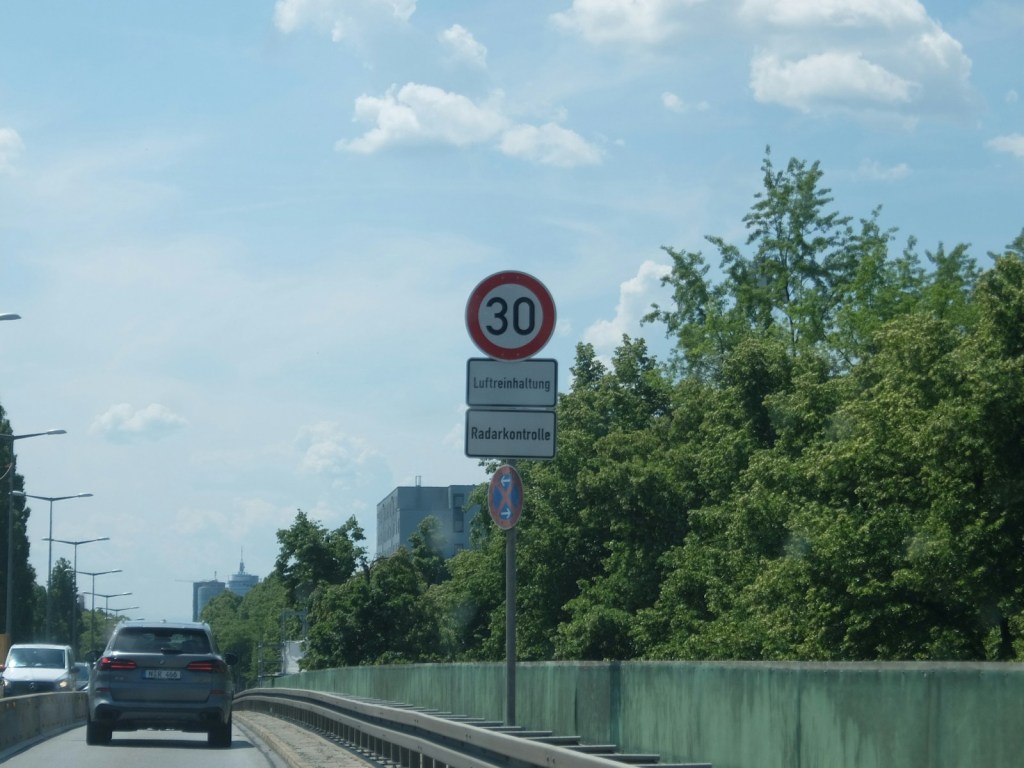
What is cosine error, and why does the angle matter?
Cosine error is the loss in measured speed that occurs when the radar beam does not point straight along the target’s line of travel. A gun can measure only the part of the motion that is directed along the beam. FanGraphs makes this point about pitched baseballs, and Wikipedia makes it about road traffic, noting that the angle between the beam and the vehicle’s path affects the reading.
An officer parked beside a road views passing cars from an angle, so the reading comes out slightly lower than the true speed. Wikipedia and The Drive both describe this effect, and Wikipedia adds that the error always favors the driver by producing a lower number. Operators are trained to position the gun so that the angle stays small. The same geometry explains why a lone gun aimed from the wrong spot can understate the speed of nearly anything it measures, from a sedan to a fastball. Drivers who want to see how highways are shaped around speed and safety can also read our article on why U.S. highway exit ramps are cloverleaf shaped.
How do police radar guns differ from lidar (laser) guns?
Lidar guns use pulsed laser light, while radar guns use radio waves, according to Wikipedia. Cobra describes the lidar beam as a narrow infrared one. The most important practical difference is how wide each beam is. The Drive explains that at about 1,000 feet (305 meters) a radar cone can widen to the full width of a highway, and Police Magazine puts the radar beam at more than 200 feet (61 meters) wide at that distance. By contrast, Police Magazine says a lidar beam at 1,000 feet is only about 3 feet (0.9 meters) wide, and The Drive says laser spreads much more slowly than radar.
A narrow beam allows an officer to single out one vehicle in dense traffic. Wikipedia and Police Magazine both describe lidar as favored for its targeting precision, whereas a wide radar beam can reflect from several vehicles at once. For that reason, police radar and lidar are often used for different situations: radar for general monitoring, and lidar when a specific car has to be identified.
How do radar guns work in baseball?
A baseball radar gun relies on the same Doppler principle. FanGraphs explains that a handheld gun emits radio waves, receives the reflections from the ball, and converts the frequency shift into a pitch speed, and Wikipedia lists baseball pitches among the things radar guns measure. Well-known brands such as Stalker use the Ka band, according to The Physics Hypertextbook and Best Car Audio.
Placement matters for the same reason it matters on a road. According to the Society for American Baseball Research (SABR), radar guns were once a common sight behind home plate, and FanGraphs says that is the only spot where a gun measures the correct pitch speed, because it points straight along the ball’s path. At the major league level, SABR notes that systems such as TrackMan and Hawk-Eye have replaced the handheld guns, and FanGraphs describes TrackMan as using a source and three spaced detectors to capture the full three-dimensional motion of the ball.

How accurate are speed guns, and how do radar detectors fit in?
Wikipedia gives a typical manufacturer margin of error of plus or minus 1 to 2 mph (about 1.6 to 3.2 km/h) and says it varies with equipment quality, calibration, the environment and operator technique. Vortex Radar likewise describes radar guns as generally accurate to about 1 mph, or 2 km/h, and stresses periodic calibration. A reading is therefore a measurement with a tolerance, not an exact value.
A radar detector is a sensitive receiver that listens for the same microwave signals, as Best Car Audio explains. Vortex Radar says a detector can warn a driver before the gun can read the vehicle, since detectors generally pick up radar from farther away, and Cobra says a powerful unit can detect signals from miles away. Many handheld guns, however, transmit only while the operator holds the trigger, according to Wikipedia and Vortex Radar, which leaves less time to react. Laser is harder to detect: The Drive says a laser reading is usually taken before a detector can help, and Vortex Radar says detectors generally do not detect narrow laser beams well. For another example of roadside sensors at work, see our article on how traffic lights detect motorcycles.
What was left out, and why?
Several details were dropped because only one reliable source supported them, or because sources disagreed. These include the invention of the radar gun by two engineers in Connecticut and the first radar speeding tickets in 1949, the specific cosine error figures for pitched baseballs (for example, about 1.5 percent at 10 degrees), the claim that a 100 mph pitch is about 12 mph slower at the plate, the accuracy ratings of individual baseball guns, the typical police cosine error of under 1 mph, the effective range of lidar, the legality of radar detectors and jammers, and the details of instant-on and similar operating modes. Sources also differ on whether lidar measures speed through the Doppler effect or through the timing of laser pulses, so that point was not stated.
Frequently asked questions
How do speed guns work?
A speed gun sends out radio waves, receives the echo from a moving object, and measures how much the echo’s frequency has changed. The size of that Doppler shift is proportional to the object’s speed, as The Physics Hypertextbook and Wikipedia describe.
How do police radar guns work differently from lidar guns?
Police radar uses radio waves with a wide beam, whereas lidar uses a narrow laser beam that can target one vehicle, according to Police Magazine and The Drive.
Which radar band is most common for police?
Ka band is the most active police band in the United States today, according to Vortex Radar and Cobra, while X band has become less common.
Can a radar gun read the wrong speed?
Yes, within limits. The angle of the beam, calibration, the environment and the operator’s technique all affect the result, and typical guns are rated to about 1 to 2 mph, according to Wikipedia and Vortex Radar.
How do radar guns work in baseball?
They bounce radio waves off the ball and read the Doppler shift, and they give the correct speed only when pointed straight along the ball’s path, as FanGraphs and SABR describe.
Radar guns turn a tiny change in frequency into a number we can read at a glance, and knowing their limits helps put every reading in context. If you enjoyed this explanation, subscribe to the Mr Global Rankss channel at https://www.youtube.com/@mrglobalrankss.
Related reading: How traffic lights detect motorcycles and Why U.S. highway exit ramps are cloverleaf shaped.
Sources
- Wikipedia: Radar speed gun
- Best Car Audio: How does a police radar gun work
- HyperPhysics (Georgia State University): Police RADAR
- The Physics Hypertextbook: Frequency of a Police Radar Gun
- Cobra Support: Radar and laser enforcement
- Vortex Radar: Police Radar: How it Works and How to Beat It
- The Drive: How Does Police LiDAR Work?
- Police Magazine: 15 things you should know about speed enforcement tools
- FanGraphs: The Physics of Radar Guns
- SABR: Radar (Gun) Love


Leave a Reply