
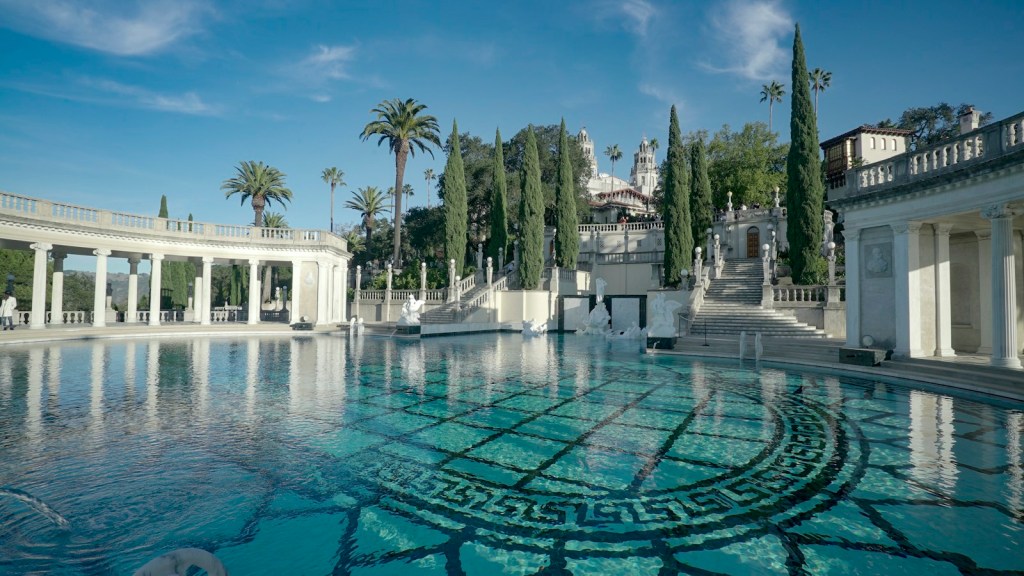
Are there any castles in the U.S.? Yes, but not in the medieval sense. The country has no castles built to defend against enemies. It has many castles built from the 1800s onward as private homes, estates and landmarks by wealthy owners who wanted the look of a European castle. Several are open to visitors, including Hearst Castle in California and the Biltmore Estate in North Carolina. This article explains the best-known castles in the U.S., when they were built, why none were made for defense, and which popular claims could not be confirmed. The details come from the Smithsonian, Mental Floss, Wikipedia and 24/7 Wall St.
Are there real castles in the U.S.?
It depends on what “real” means. Wikipedia’s list of castles in the United States notes that none are castles in the original medieval sense. Most are country houses or follies built to look like castles, though a few are actual fortifications. Mental Floss makes the same point in a different way, noting that none of the castles it features were constructed to ward off enemies.
So the honest answer has two parts. If a castle must be a fortified medieval stronghold, the U.S. has none. If a castle can be a large, castle-style building with towers, turrets or battlements, the U.S. has dozens, and 24/7 Wall St. describes many of them as real castles that visitors can tour.
What are the best-known castles in the U.S.?
Several appear on more than one list. Smithsonian Magazine and Wikipedia agree on the following.
- Hearst Castle, California. Built from 1919 to 1947 for William Randolph Hearst and designed by architect Julia Morgan.
- Biltmore Estate, North Carolina. Built for the Vanderbilt family and completed in 1895 to a design by Richard Morris Hunt.
- Bishop Castle, Colorado. Begun in 1969 by Jim Bishop, who built it himself.
- The Smithsonian Castle, Washington, D.C. Completed in 1855 in the Norman style and designed by James Renwick Jr.
- Bannerman Castle, New York. Built by Francis Bannerman VI to store a military surplus business and abandoned in 1918.
Mental Floss and Wikipedia also overlap on others. Boldt Castle in the Thousand Islands of New York was built between 1900 and 1904 and then left unfinished and abandoned, and Lyndhurst in New York dates to 1838. Iolani Palace in Honolulu, completed in 1879, appears in both Mental Floss and the Smithsonian’s list as a royal residence in castle form.
Why were castles built in the U.S. if not for defense?
For comfort, prestige and imagination. Mental Floss describes the buildings as homes, retreats and statements of wealth, and Wikipedia calls most of them country houses or follies, a folly being a building made to look like something it is not. Their owners were often rich industrialists or families with ties to Europe who borrowed the style of medieval castles, and builders had the money to give them towers and grand halls.
One castle was built for business rather than display. The Smithsonian and Wikipedia both describe Bannerman Castle as an arsenal for Bannerman’s military surplus company, built on an island between 1901 and 1918, which makes it one of the few where the look had a practical purpose.
Why are there no medieval castles in the U.S.?
The sources reviewed agree on the fact but give little of the reasoning, so this article keeps to what they state. Wikipedia says none of the listed castles are castles in the medieval sense, and Mental Floss says none were built to ward off enemies. The dates also show the pattern: the examples above range from 1838 for Lyndhurst to 1969 for Bishop Castle, long after the medieval period. The castles that exist were built as architecture, not defense.
Which castles in the U.S. can you visit?
Many are open to the public. The Smithsonian lists six it describes as castles you can visit, including Hearst Castle, the Biltmore Estate, Iolani Palace, Bishop Castle, the Smithsonian Castle and Bannerman Castle. Mental Floss lists eleven, adding places such as Boldt Castle, Lyndhurst, Hammond Castle and Castello di Amorosa, a winery in California that was begun in 1994 and opened in 2007. Opening hours and tour rules change, so anyone planning a trip should check each site’s own page first.
What was left out, and why?
Several popular claims were dropped because only one source supported them. They include the statement that Bacon’s Castle in Virginia, dated to 1665, is the oldest on the list, the room count at Hearst Castle, and the claim that the Biltmore is the largest home in the U.S. Each may be true, but none could be confirmed by a second source here. The photograph at the top of this page shows Hearst Castle in San Simeon, California.
Frequently asked questions
Are there real castles in the United States?
There are real, standing castle-style buildings, but none from the medieval period, according to Wikipedia and Mental Floss.
When was Hearst Castle built?
Between 1919 and 1947, for William Randolph Hearst, with Julia Morgan as architect, according to the Smithsonian and Wikipedia.
When was the Biltmore Estate completed?
In 1895, according to the Smithsonian and Wikipedia, which dates construction from 1889.
Were any castles in the U.S. built for defense?
Not the ones usually visited. Mental Floss says none of its castles were built to ward off enemies, and Wikipedia notes that a few listed buildings are true fortifications.
Thanks for reading. If you enjoy clear explanations of how the world works, subscribe on YouTube at https://www.youtube.com/@mrglobalrankss.
Related reading: Why does Michigan have an Upper Peninsula? and What is the tallest waterfall in the U.S.?


Leave a Reply