
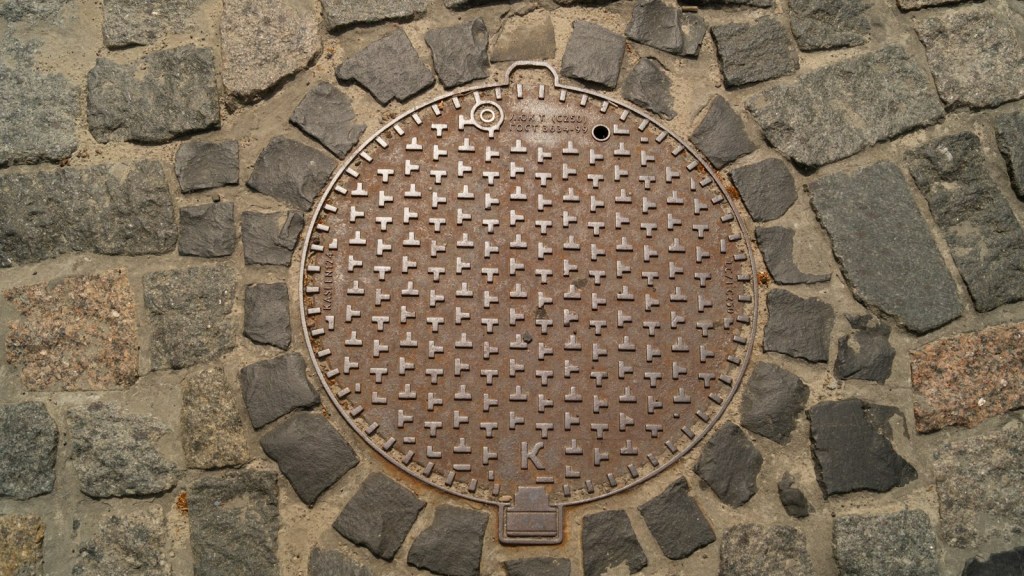
Why are manhole covers round? Manhole covers are round mainly because a round cover can never fall through its own opening, no matter how it is turned. A circle has the same width in every direction, so it cannot slip through a hole of the same shape. Round covers are also easy to roll, and they are simpler and cheaper to make. The question is famous as a job interview puzzle, but the answer is practical engineering. This article explains why manhole covers are round, why a square cover can fall in, and which popular explanations could not be confirmed. The details come from Live Science, Science News and Mental Floss.
Why can’t a round manhole cover fall through its hole?
This is the reason most often given, and it is a matter of geometry. Live Science explains that a round cover cannot drop back through its opening when it is turned, while a square cover can fall through if it is rotated diagonally. Science News gives the reason: a circle has a constant diameter, so a round lid cannot be angled to slip through a hole of the same shape, whereas an oval, square or hexagonal lid can be tilted through its matching opening. Mental Floss makes the same point, noting that the cover is wider than the hole in every direction and so cannot drop in whatever its orientation.
The reason a square cover fails is its diagonal. The distance from one corner of a square to the opposite corner is longer than the length of its sides, so a square lid that is turned to line up with the diagonal of the opening has room to slide through. A circle has no such longer direction, because it measures the same across in every direction.
Are manhole covers round because they are easy to roll?
That is another practical benefit. Live Science notes that once a round cover has been removed, it can simply be rolled along the ground. Mental Floss agrees that because the covers are heavy, a round shape lets workers roll them from place to place instead of carrying them.
Are round manhole covers easier and cheaper to make?
Yes, according to two of the sources. Live Science says manholes are typically made with rotational tools, which naturally produce circular shapes, and that a round cover is cheaper and easier to produce because its surface area is smaller than that of a square cover of similar width. The article quotes Josh Nelson of San Jose State University: anything else would be more complicated and less economical. Mental Floss likewise says round shapes are simpler to make than square or rectangular ones. A circular opening is also the natural match for a circular cover, so one shape serves both parts.
Is there only one reason manhole covers are round?
No. Live Science says plainly that there is no single definitive reason, and that the shape depends on how people perceive it, how it is manufactured, how much material it needs and what it has to do. The most defensible summary is that several advantages point the same way: a round cover is safe because it cannot fall in, convenient because it rolls, and economical because it is easy to make. Any one of these would be a good reason, and together they explain why the round design became the standard.
Seen together, the reasons reinforce one another. Mental Floss lists a cover that cannot fall in, one that can be rolled and one that is easier to manufacture, and Live Science names the same three themes of safety, movement and cost.
Why is “why are manhole covers round?” a famous interview question?
It became a standard test of reasoning. Live Science reports that the question became widely known in the 1990s, when Microsoft asked it in job interviews, and Mental Floss notes that it also appears in a well-known guide to job interviews. Interviewers like the puzzle because it has several reasonable answers, so a candidate can show how they think more than what they remember.
What was left out, and why?
Some popular claims were dropped because only one source supported them. They include the idea that a round cover best resists the pressure of the surrounding earth, the claim that round covers are easier to align, the typical weight of a cover (given as a range by one source), the date when cities first built underground sewers, and the details of the Reuleaux triangle, a shape of constant width. Each is interesting, but none could be confirmed by a second source here. The sources also do not say whether any square or other noncircular covers are in use, so this article makes no claim about that.
Frequently asked questions
Can a square manhole cover fall through its hole?
Yes, if it is turned diagonally, according to Live Science and Science News.
Can a round manhole cover fall through its hole?
No. A circle has the same width in every direction, so it cannot slip through a hole of the same size, as Science News and Mental Floss explain.
Are manhole covers round because they are easier to roll?
That is one benefit. Live Science and Mental Floss both say a removed round cover can be rolled instead of carried. It is one of several reasons, not the only one.
Is there a single reason manhole covers are round?
No. Live Science says there is no single definitive reason, and Mental Floss lists several advantages that work together.
Thanks for reading. If you enjoy clear explanations of how the world works, subscribe on YouTube at https://www.youtube.com/@mrglobalrankss.
Related reading: Why does Michigan have an Upper Peninsula? and What is the tallest waterfall in the U.S.?


Leave a Reply