
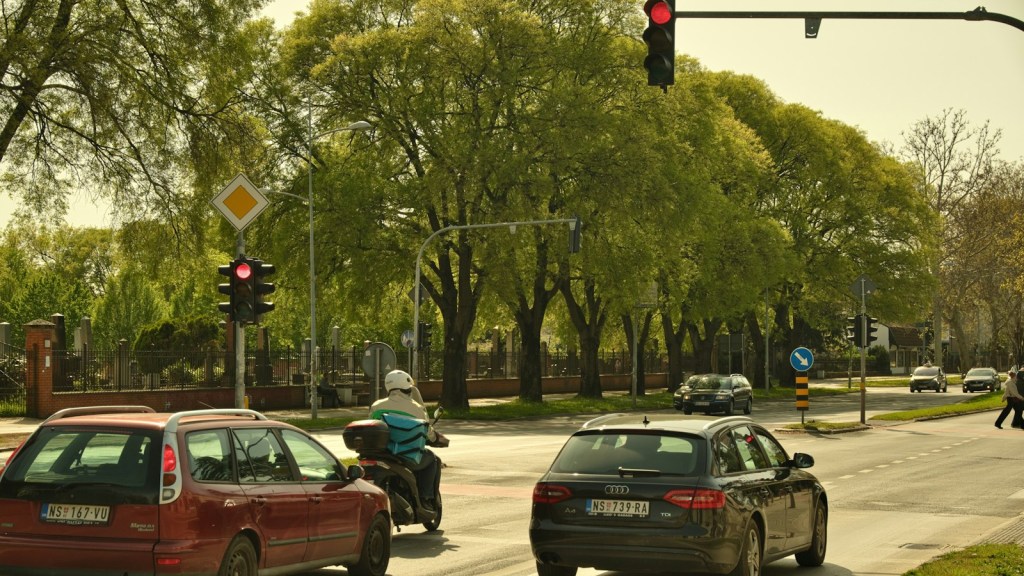
How do city traffic lights automatically detect motorcycles sitting at a left turn lane? In most cities the traffic light sensor is a loop of wire hidden under the pavement, and it works by sensing the metal in a vehicle. It usually does the job well, and sometimes it fails. A motorcycle contains far less metal than a car, so a loop that notices every sedan can overlook a lone rider. This guide explains how a traffic light sensor in the road works, why a motorcycle can be missed, how cameras and radar differ, and what riders can do when a signal will not change.
How does a traffic light sensor work?
The most common traffic light sensor is the inductive loop. Crews cut a shallow square into the pavement with a saw, lay insulated wire in the cut, and fill it with black sealant. If you look closely at the road just behind a stop line, you can often see thin lines forming a square, and that square is the loop. A typical loop measures about six feet by six feet, which fits inside a standard twelve-foot lane. The same design is used whether the loop sits in a through lane or a left turn lane.
A detector box beside the road sends rapidly alternating current through the wire, which creates a small magnetic field above the pavement. When a vehicle stops over the loop, electric currents form in its metal, and those currents lower the loop’s inductance. The box senses that change and tells the traffic signal controller that a vehicle is waiting. The controller then adds that lane to the signal sequence, which is how a quiet left turn lane eventually gets its green arrow.
Why can a traffic light sensor in the road miss a motorcycle?
The loop does not see a vehicle. It senses metal. A car has a large mass of metal close to the ground, so it changes the loop’s inductance a great deal. A motorcycle has far less metal, and it can sit higher above the loop, so the change can be too small for the detector box to register. The rider is waiting at the line, but the controller never receives the call.
Engineers can raise the sensitivity of the detector, but that creates a different problem: a more sensitive loop may react to traffic in the next lane and ask for a green light that nobody is waiting for. Sensitivity is therefore a trade-off between catching small vehicles and avoiding false calls, which is why the same intersection can seem to treat a motorcycle differently from one season or one signal setting to the next.
What is a quadrupole loop, and does it help?
Some intersections use a double loop shape called a quadrupole. It adds an extra wire down the middle of the loop, which concentrates the sensing field near the center of the lane and senses small vehicles better than a plain square. The Federal Highway Administration’s detector handbook lists the quadrupole among the standard loop layouts, and agencies choose it where small vehicles are a concern.
Do camera and radar traffic light sensors work better?
Other intersections skip the wire and use a camera or a radar sensor mounted on the signal pole or mast arm. These sensors do not depend on metal in the same way, but they have limits of their own. Cameras watch for changes in contrast, so glare, or a light colored vehicle on light pavement, can still cause a miss. No single traffic light sensor is perfect, which is why cities mix loops, cameras and radar depending on the location.
Where should a motorcycle stop at a signal?
Riders are often advised to stop right on the saw cut lines of the loop, because the wire runs along them. Stopping on those lines puts the most metal, including the engine, frame and wheels, closest to the wire. If the light still never changes, the city can adjust the sensitivity, so it is worth reporting the signal to your local public works or traffic engineering office, with the intersection and the direction of travel.

Can a motorcycle legally go through a red light that never changes?
Some states have laws, often called dead red laws, that let motorcyclists proceed through a signal that never detects them. The rules differ from state to state, including how long a rider must wait and what counts as a malfunctioning signal, so check your own state’s law before relying on one. This article is general education and not legal advice.
Frequently asked questions
Do traffic lights detect motorcycles?
Usually, yes. An inductive loop under the pavement senses the metal in a motorcycle, but it detects a motorcycle less reliably than a car because a motorcycle has much less metal.
Why do traffic lights not change for motorcycles?
The change in the loop can be too small for the detector box to notice. Low sensitivity settings, a rider stopped off the wire, or a camera confused by glare can all cause the same result.
What are the lines cut into the road at a traffic light?
They are saw cuts filled with black sealant that hold the loop of wire, usually a square about six feet on each side.
Who can fix a traffic light that ignores my motorcycle?
Your city or county public works or traffic engineering office can adjust the detector sensitivity, so report the intersection and the lane where the signal fails to respond.
If you enjoy explainers like this, browse more in our Facts section and subscribe to Mr Global Rankss on YouTube for more everyday science.
Related reading: Why highway exit ramps are shaped like a cloverleaf and the tallest buildings in the world and the engineering behind them.
Original T-Shirt Designs
Wear what you believe in
Two original designs, each built on a single word of hope and peace.


Leave a Reply