
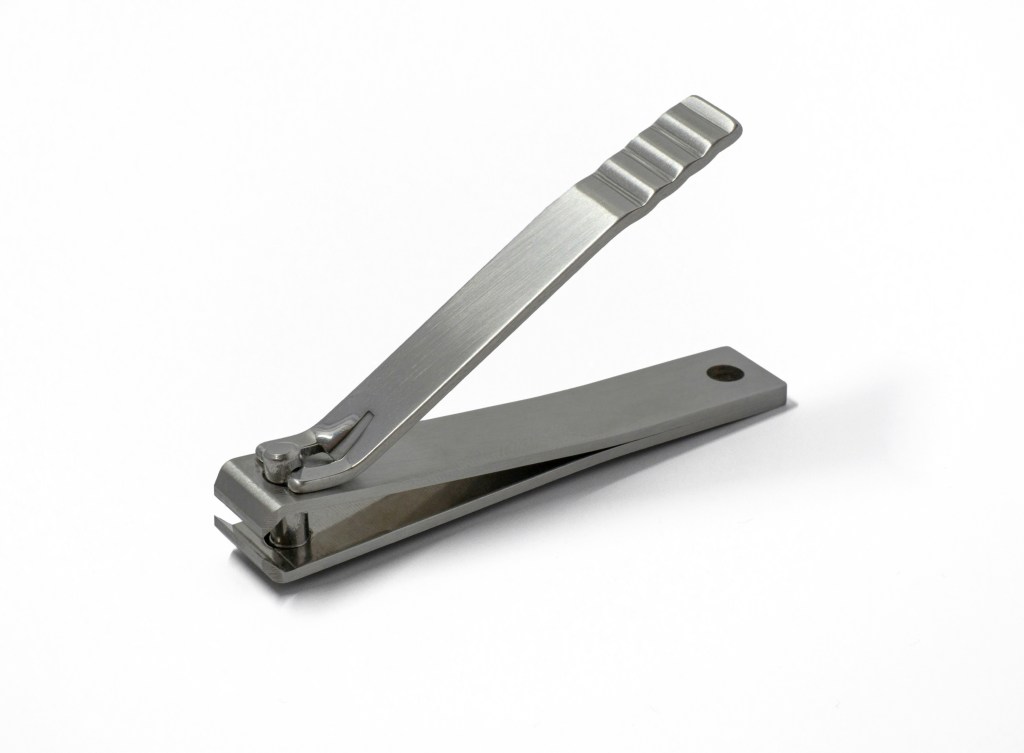
Before the nail clipper existed, people trimmed their nails with whatever small cutting or abrasive tool was at hand: a penknife, a pair of scissors, a file, a rough stone, or simply their teeth. Wealthy households in ancient Egypt employed manicurists, barbers in Greece and Rome pared nails as part of their work, and by the 1700s fitted cases carried scissors and files. The first U.S. patent that historians identify as a nail trimmer was granted in 1875, and the lever clipper we recognize today took shape between 1881 and 1905.
Key facts
- Egypt employed palace manicurists by the Fifth Dynasty, with a small knife and file as their tools.
- Gold grooming kits with tweezers and picks come from the Royal Cemetery of Ur, dated to about 2600 to 2500 BCE.
- Greek and Roman barbers pared nails as part of their work.
- Roman toilet sets pair tweezers with nail cleaners and ear scoops.
- Eighteenth-century etuis packed scissors, knives and nail files into one small case.
- Under the Qing dynasty, long nails signaled freedom from manual labor.
- March 23, 1875: Valentine Fogerty’s file-type nail trimmer, U.S. patent No. 161,112.
- July 26, 1881 and August 22, 1905: the clamp (Heim and Matz) and two-lever (Carter) trimmers followed.
A nail clipper costs very little and takes no skill to use, which makes it easy to forget that it is a young invention. For most of human history, keeping nails short and tidy meant a steady hand, a sharp edge and sometimes a hired professional. The answers below follow the evidence from four ancient cultures, through the small grooming cases of the eighteenth century, to the patents that produced the modern clipper. Because fingernail clippings rarely survive, much of the story has to be inferred from tools, tomb titles and occasional literary remarks, and this article says plainly where that inference is all we have.
How did people trim their nails before nail clippers existed?
No single method ever dominated, and the evidence is mostly indirect. Nails are soft tissue and leave no trace, so what survives are grooming tools, catalogue records and passing remarks in ancient texts. Researchers reason backward from those objects to the habits behind them.
Three approaches recur across the sources. The first was cutting with a blade. In a verse letter by the Roman poet Horace, a man sits in an empty barber’s booth, penknife in hand, quietly cleaning his nails (Horace, Epistles 1.7, in A. S. Kline’s translation), and Tedium’s history of nail trimming notes that people long cut nails with a knife or small scissors. The second was filing. An eighteenth-century case now in the Metropolitan Museum of Art holds a tool that has tweezers at one end and a nail file at the other (Metropolitan Museum of Art).
The third was biting. ScienceABC describes biting and tearing off a nail as a fallback when no tool was available, and Tedium suggests that people may have bitten nails short before tools existed. Neither source points to a specific archaeological find, so biting is a plausible habit rather than a documented one.
It is also worth separating two jobs that modern readers tend to merge. Cleaning under the nail and shortening the nail were handled by different instruments, and most of the ancient objects described below belong to the first category.
What did ancient Egyptians use to care for their nails?
The Egyptian elite did not do this work themselves. The World History Encyclopedia reports that manicurists served the king and the upper class, tending both fingernails and toenails with a small knife and a file, and that the king’s manicurist held a prestigious post. The same article admits that how ordinary people managed their nails is not recorded.
The title appears in the tombs of court officials. A study of Egyptian hairstyles lists Khabauptah, an official of the Fifth Dynasty, as an Overseer of Palace Manicurists, a post that sat alongside his career as a palace hairdresser. A separate account of the Saqqara tomb of Niankhkhnum and Khnumhotep reports that both men held the title of overseer of the manicurists under King Niuserre (Egypt Fun Tours), which it dates to about 2400 BCE.
Physical evidence is sparse. The Harvard Giza Project catalogues a gold manicure implement from the Fourth Dynasty, the reign of Khufu, but the record does not describe its shape or wear, so we cannot say whether it cut, filed or pushed back the skin. What the evidence does support is that nail care in Egypt was a recognized profession, close to the king, at least by the middle of the third millennium BCE.
What do the royal graves of Ur reveal about grooming in Mesopotamia?
Mesopotamia offers fewer clues, and they come from burials rather than texts. The Royal Cemetery of Ur, excavated by Leonard Woolley between 1926 and 1931, held graves whose jewelry the Metropolitan Museum of Art dates to about 2600 to 2500 BCE. Among the grave goods were small grooming kits.
The University of Pennsylvania Museum holds a reproduction of a gold vanity case from Ur, the original being in Baghdad. A cone-shaped case held instruments hanging from a silver ring: two picks, a spoon and a pair of tweezers. A site devoted to the royal tombs describes gold tweezers and a stiletto from Queen Puabi’s tomb and notes that kits made of precious metal served as status symbols.
Here the caution matters most. Neither record says that any of these instruments was used on nails, and this research found no document from the period describing nail cutting. The kits show that elite Mesopotamians carried small personal tools in ornate cases. They do not, on their own, show how a nail was trimmed.
How did the Greeks and Romans trim and clean their nails?
Here the written record is better. In Smith’s Dictionary of Greek and Roman Antiquities the entry on the barber states that the third part of a barber’s work was to pare the nails of the hands, which the Greeks described with their own verbs for the task. The entry cites Plautus, in whose play the miser Euclio’s barber has cut his nails, and Tibullus, who refers to nails cut by a skilled barber’s hand.
A scene in Horace points the same way, since the man in the barber’s booth with a penknife is evidently at home there (Poetry in Translation). Sources differ on the exact date of the poem, with popular summaries placing it between 35 and 20 BCE, so no date is given here.
Archaeology adds the Roman toilet set. The London Museum holds a Roman copper alloy cross-bar carrying six instruments, including tweezers and several nail cleaners, and says such sets are common finds in Roman Britain. A single nail cleaner from Winchester, dated by Hampshire Cultural Trust to the third or fourth century CE, probably hung on a ring with an ear scoop and tweezers. Museum Wales describes the same trio as the standard set.
None of these catalogues explains how each tool was used, and the name “nail cleaner” implies scraping dirt from beneath the nail rather than shortening it. Cutting appears to have fallen to the knife and to the barber.
Barbers handled far more than nails. For the wider picture of ancient grooming, see how people in Ancient Greece shaved and how people shaved before razors.
What role did long nails play in China?
In China the surviving evidence is less about trimming than about keeping nails long. The Pitt Rivers Museum explains that, under the Qing dynasty, long nails signaled that a woman did no manual labor, and that protective covers for them were tied to the high culture of the Manchu court. Day versions were made of silver or tortoiseshell and decorated with gold, enamel or gems, while bedtime versions were plain wood. Most surviving examples date from the late nineteenth century.
An article in Sixth Tone adds that upper-class women wore nail guards in both the Ming and Qing dynasties, and that the fashion faded after the fall of the Qing in 1911. Tedium likewise reports that long nails marked a person who did not do hard labor under the Ming. Sources differ on the length of the Empress Dowager Cixi’s nails, giving over three inches in one case and about six in another, so no figure is relied on here.
No well-documented ancient Chinese nail-cutting tool turned up in this research, so none is claimed. The lesson of the Chinese material is social: wherever nails were left long, short nails identified the laborer, and trimming was a matter of status as much as hygiene.
What did people use in the 1700s, just before the clipper?
By the eighteenth century, nail care had settled into a small portable kit. The Science Museum Group’s silver, gold and shagreen etui from that century holds steel scissors with pointed blades, tweezers combined with a nail file, a knife blade and an ear spoon, all in a case 86 millimeters (about 3.4 inches) long. The Metropolitan Museum’s enameled copper etui from about 1765 to 1770, made in South Staffordshire, England, held a penknife, tweezers and a nail file.
A third item, an Italian silver toilet set from the same century, pairs an ear scoop with two nail scrapers in a velvet-lined leather case, although the museum record does not say what the scrapers were for. Together these objects show that scissors, files and knives were the standard answer, and that none of them was a dedicated device made only for trimming nails.
The same kind of small personal kit also served other daily routines, as in how people cared for their teeth in the 1800s.
When and how was the nail clipper invented?
The honest answer is that it developed in steps. Tedium states that it is unclear who invented the modern clipper, and the patent record shows a gradual change from files, to clamps, to levers.
The earliest U.S. patent usually named is that of Valentine Fogerty. The patent text identifies him as being of Boston, Massachusetts, and the document, titled Improvement in finger-nail trimmers (No. 161,112), is dated March 23, 1875. Its device held a fingertip in a concave body while a ring-mounted cutter, moved by a lever handle, trimmed the nail to the segment of a circle, and the inventor preferred file-type cutters that produced filings rather than chips. In other words it was closer to a nail file than to a clipper. ScienceABC also gives 1875 for Fogerty’s filing, and Tedium describes the design as a circular nail file.
The clamp came next. Eugene Heim and a co-inventor, both of Cincinnati, Ohio, received patent No. 244,891 on July 26, 1881, for a trimmer built from a single U-bent plate of spring steel with two nipping jaws. A cam-headed lever pressed the jaws together, the lever’s rear surface worked as a rasp, and a hook allowed the tool to hang from a belt or watch-chain. Tedium regards it as the first design that resembles modern clippers. The second inventor’s name is spelled “Oelestin” in the patent’s scanned text and “Celestin” in ScienceABC, and this article does not try to settle the difference.
The familiar plier form followed. Chapel S. Carter of Ansonia, Connecticut, assigned to the H. C. Cook Company, was granted a patent for a finger-nail trimmer on August 22, 1905. It used two pressed sheet-metal levers on a pivot, a spring, a sliding lock with a pointed nail cleaner, and a roughened face that served as a file. ScienceABC calls it an influential 1905 patent for the modern lever-style clipper.
- March 23, 1875: Valentine Fogerty’s file-type trimmer, U.S. patent No. 161,112 (patent text).
- July 26, 1881: Heim and Matz’s spring-steel clamp trimmer, U.S. patent No. 244,891 (patent text).
- August 22, 1905: Chapel S. Carter’s two-lever plier trimmer, assigned to H. C. Cook Company (patent text).
Frequently asked questions
Did people bite their nails because they had no tools?
Possibly, but the evidence is indirect. ScienceABC describes biting as a fallback, and Tedium suggests it may have preceded tools. Neither cites an archaeological find.
Who invented the nail clipper?
No single inventor is clear. Tedium says the origin is unclear, and the patents show steps from Fogerty in 1875 to Heim and Matz in 1881 and Carter in 1905 (ScienceABC).
What is the oldest known nail clipper patent?
The earliest U.S. patent usually named is Valentine Fogerty’s No. 161,112, dated March 23, 1875 (Google Patents). It described a file-type trimmer rather than a clamp, so the clamp design dates from 1881 (patent No. 244,891).
Did the Romans have special tools for their nails?
Yes, in the form of small nail cleaners attached to toilet sets with tweezers and ear scoops. The London Museum and Hampshire Cultural Trust both hold examples from Roman Britain.
Did ancient Egypt have professional manicurists?
Yes. The World History Encyclopedia says manicurists served the king and upper class, and a study of Egyptian hairstyles records an Overseer of Palace Manicurists from the Fifth Dynasty.
The humble clipper is a young tool, and for most of history nail care meant a small blade, a file and a steady hand.
Related reading: how people in Ancient Greece shaved, how people shaved before razors and how people in the 1800s curled their hair.
Sources
- Pitt Rivers Museum, Body Arts: Fingernails and manicures
- Tedium: The Long, Slightly Strange History Behind Fingernail Clipping
- ScienceABC: Before Clippers, How Did Humans Trim Their Nails?
- World History Encyclopedia: Cosmetics, Perfume, and Hygiene in Ancient Egypt
- Harvard Giza Project: Gold manicure implement (GEM_6464)
- Science Museum Group: Etui (A642428)
- Science Museum Group: Toilet set with ear scoop and nail scrapers (A642659)
- Smith’s Dictionary of Greek and Roman Antiquities, Barba (University of Chicago, Penelope)
- Poetry in Translation: Horace, Epistles Book I, Epistle VII
- University of Pennsylvania Museum: Toilet Kit (29-22-11B)
- Sumerian Shakespeare: Miscellaneous items from the Royal Tombs of Ur
- Metropolitan Museum of Art: Ur, The Royal Graves
- Egypt Fun Tours: The Tomb of Khnumhotep and Niankhkhnum
- The Social and Ritual Contextualisation of Ancient Egyptian Hair and Hairstyles (PDF)
- London Museum: Toilet set (A20136)
- Hampshire Cultural Trust: Copper alloy nail cleaner, Victoria Road, Winchester
- Museum Wales: Roman copper alloy toilet set (97.7H/4)
- Sixth Tone: Why Long Fingernails Were All the Rage in Ancient China
- The World of Chinese: Nailed It, Why Long Fingernails Were All the Rage in Ancient China
- Metropolitan Museum of Art: Etui, South Staffordshire, ca. 1765-70
- Google Patents: US161112, Improvement in finger-nail trimmers
- Patent viewer: US244891, Finger-Nail Trimmer
- Patent viewer: US797937, Finger-Nail Trimmer


Leave a Reply