
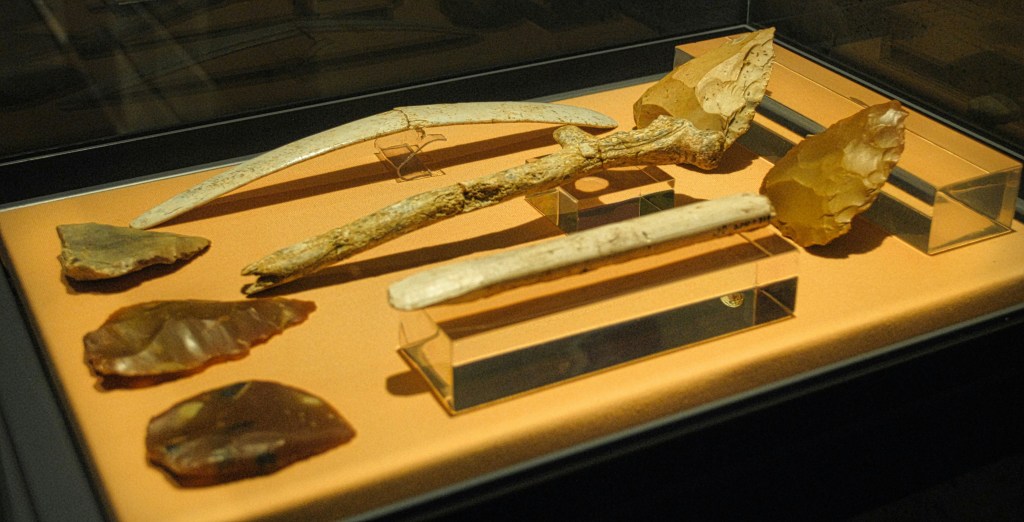
Nobody can say for certain, because no Stone Age nails, nail clippings or tools marked for the purpose have been identified. The most reasonable reconstruction is that hard daily work shortened nails, that people bit or tore away what remained, and that a sharp flake of stone or edge of shell may sometimes have been used to pare them. The earliest tweezers and small blades found in the sources consulted are bronze, and spring clippers were patented in the 1870s.
Key facts
- No direct evidence of Stone Age nail trimming has been found; the topic rests on inference.
- Fingernails grow about 3 millimeters a month; toenails about 1.5 millimeters.
- Nails are made of keratin, which is hard but flexible, and they serve as everyday tools.
- Modern studies link use of the dominant hand, and trauma to a nail, with faster growth.
- Sharp stone flakes were used for cutting and scraping more than 1.8 million years ago.
- Neanderthals at Moscerini, Italy, made scrapers from clam shells about 100,000 years ago.
- Keratin decomposes in burial, so nails are rarely preserved.
- The earliest tweezers and small blades cited here are Bronze Age, and nail clipper patents date to the 1870s.
Few questions about the distant past sound as simple as this one, and few are as hard to answer honestly. Nails are made of a protein that rarely survives burial, and nothing in the sources consulted for this article documents Stone Age nail care directly. What can be done is to combine three kinds of knowledge: how nails behave in the living body, what the tools of the period could do, and what ancient teeth reveal about the work of the hands and mouth. This article takes each in turn and marks, as clearly as it can, where evidence ends and inference begins.
How Did People in the Stone Age Cut Their Nails?
The short answer is that nobody knows for certain. A columnist answering this very question for BBC Science Focus says there is no firm evidence for any method, and a history of nail trimming published by Tedium likewise offers no archaeological proof for prehistoric practice, only speculation. Both are right to be cautious. What follows is a reconstruction from indirect clues, not a finding.
Three explanations are usually proposed. The first is that hard daily work simply wore nails down. The second is that people bit, tore or pulled off any length that became a nuisance. The third is that a sharp edge of stone or shell was used to pare or scrape the nail. These possibilities are not mutually exclusive, and the Stone Age ran for well over a million years: the Smithsonian holds a flaked chopper from Olduvai Gorge, Tanzania, about 1.8 million years old (Smithsonian Human Origins), and excavations in Kenya point to stone toolmaking that is older still (Smithsonian Magazine). Over so long a span and across so many climates, more than one habit very probably existed. That is itself an inference, and so are the three explanations. The sections below show how much support each one has.
How Do Fingernails Grow, and Why Does Heavy Daily Use Matter?
A nail is built from sheets of dead cells packed with keratin, a tough protein, and it is produced by the matrix, a layer of living tissue at the base of the nail that lies mostly beneath the skin. An open human biology textbook (Human Biology, Pressbooks) describes the result as hard but flexible, and the Cleveland Clinic identifies keratin as the main component of the nail plate.
Growth is steady and slow. The Cleveland Clinic gives about 3 millimeters (roughly one eighth of an inch) a month for fingernails and about 1.5 millimeters a month for toenails. The textbook also puts the average at 3 millimeters a month, while Healthline reports 3.47 millimeters for fingernails and 1.62 for toenails, so published figures differ slightly. A fingernail that is never worn away would therefore lengthen by roughly 3.6 centimeters (about 1.4 inches) in a year, a figure that follows from simple arithmetic on the rate above. A lost fingernail takes about six months to regrow and a lost toenail from 12 to 18 months, according to the Cleveland Clinic.
Nails are also working parts of the hand. Both the textbook and the Cleveland Clinic list protection of the fingertip and a sharper sense of touch among their functions, and both describe the nail as a practical tool, for scratching and for picking up small objects. The textbook adds that fingernails permit a fine precision grip and can be used for cutting or scraping. It is reasonable to suppose that a hand which dug, gathered, stripped and processed materials every day exposed its nails to constant friction and knocks.
Modern research suggests that nails respond to this kind of use. Healthline notes that nails on the dominant hand and on longer fingers tend to grow faster, and an article from NYU’s Clinical Correlations, reviewed by a physician, proposes that trauma may raise the blood and nutrient supply to a nail and so speed its growth. Both also link nail biting to faster growth, although Healthline adds that the habit harms the nail. These findings come from living people. They show that nails adapt to use, not that Stone Age people kept short nails.
What Do Stone, Shell and Bone Tools Show?
Flaked stone is among the oldest evidence of deliberate cutting tools. The Smithsonian explains that striking flakes from a stone core left a sharp edge useful for cutting, and Smithsonian Magazine reports that early flakes were used for cutting and scraping. A review of prehistoric tool miniaturization summarized by Futurity says that small flakes served for piercing, cutting and scraping.
A sharp flake could, in principle, pare a nail. The surviving evidence, however, concerns other work. The Smithsonian page describes cutting meat and extracting marrow, and the Kenyan site described by Smithsonian Magazine yielded signs of hippopotamus butchery and plant processing. None of the sources consulted for this article identifies a stone tool as having been used on nails. The idea that a flint edge might have trimmed a nail rests on what such edges could do, not on traces left by the act.
Shell edges at Grotta dei Moscerini
Shell offers a more specific case. At Grotta dei Moscerini, a Neanderthal cave in Italy that opens onto a beach, researchers led by Paola Villa examined 171 modified shells of the Mediterranean smooth clam, dated to about 100,000 years ago. Most had been retouched to serve as scrapers, according to EurekAlert and ScienceDaily, and the authors point out that the thin, sharp shell edge can be resharpened. BBC Science Focus adds that the same cave held abundant pumice, likely used as an abrasive tool. None of these reports connects the shells or the pumice to nail care, so any such use remains conjecture.
Bone tools and personal ornament
Bone was shaped into pointed tools well before the end of the Stone Age. Archaeology magazine reports eyed needles of bone dating to roughly 40,000 to 20,000 years ago, and Britannica lists needles among the bone, antler, ivory and shell tools and ornaments of the Late Paleolithic. A study of two caves in Georgia, published in PLOS ONE, describes bone awls, needles and chisels among the Upper Paleolithic tools found there. A pointed bone could plausibly have cleaned beneath a nail, but no source examined here says that it did.
People of the period plainly cared about appearance. At Blombos Cave in South Africa, 41 perforated shells dated to about 75,000 years ago appear to have been strung as ornaments, according to ScienceDaily and a National Science Foundation release carried by EurekAlert. Such finds show a concern for personal display. They say nothing directly about how nails were kept.
Could Stone Age People Have Bitten or Scraped Their Nails?
The best evidence that the mouth was a working tool comes from teeth. Kristin Krueger of Loyola University Chicago and colleagues examined casts of 45 Neanderthal teeth and 30 early modern human teeth and found vertical scratches, likely from biting food, and horizontal scratches, likely from gripping objects that were pulled back and forth (PBS NOVA). A separate study of the Neanderthals of Krapina, Croatia, by Krueger and Peter Ungar, concluded that their front teeth served only occasionally as a third hand rather than being clamped as hard as those of some Arctic peoples (Central European Journal of Geosciences).
These studies carry caveats. Hides and plant fibers rarely survive, so the materials being gripped must be inferred from the marks alone, and the Krapina sample is small. More to the point, neither study addresses nails. The marks show that the front teeth were used for tasks, which makes biting off a ragged nail an easy thing to imagine. They do not show that anyone did so.
Modern habits offer a loose parallel. Nail biting is described in a medical review by Ahmad Ghanizadeh as a widespread habit, and the same review lists nail bed damage and infection among its consequences. Healthline likewise says that it harms the nail. If Stone Age people bit their nails, they would have taken the same risks. As for scraping, the idea that a person could have filed a nail against rough stone appears only as a suggestion in the BBC Science Focus column, with no evidence offered.
Hair raises the same evidence problem; see how people in the Stone Age cut their hair.
Why Has No Direct Evidence of Nail Care Survived?
The principal reason is chemical. Keratin generally decomposes in the ground, so hair and nails survive only in unusual conditions such as permafrost, according to a review in Genes by Green and Speller. Experiments reported by von Holstein and colleagues found that keratin buried in wet conditions is broken down by microbial and chemical processes. Stone Age nail clippings, or the nails of a Stone Age burial, are therefore not something archaeologists should expect to recover.
The second reason is that a flake or shell used on a nail would look like any other flake or shell. Without a nail to test it against, a worn edge cannot be tied to that task. This is an inference about the limits of the method, not a finding.
What Is Established, and What Is Only Inference?
Supported by the evidence
- Fingernails are made of keratin and grow at about 3 millimeters a month, and toenails more slowly (Cleveland Clinic; Human Biology).
- Sharp stone flakes were being made and used for cutting and scraping more than 1.8 million years ago (Smithsonian; Smithsonian Magazine).
- Neanderthals at Moscerini made scrapers from clam shells about 100,000 years ago (EurekAlert; Science Focus).
- Neanderthals and early modern humans used their teeth as tools (PBS NOVA; Krueger and Ungar).
Inference only
- That daily labor wore nails short, which writers such as the Science Focus columnist and Tedium offer as likely but do not demonstrate.
- That people bit or tore their nails, which is suggested by tooth wear and by modern habits but is not documented for the Stone Age.
- That a flake, a shell edge, a bone point or an abrasive stone was used on nails, which has not been shown by any study consulted here.
Not known
- Whether practices differed by region, climate, age, sex or occupation.
- Whether nail length carried any social meaning in the Stone Age.
When Did Dedicated Nail and Grooming Tools Appear?
The earliest grooming implements identified in the sources consulted come from after the Stone Age. The Metropolitan Museum of Art holds bronze tweezers from Minoan Crete dated to about 2900 to 1050 BCE, and notes that the type became standard on the island in the Late Bronze Age (The Met). The Science Museum Group holds a bronze set from Egypt, dated 1500 to 1001 BCE, that combines tweezers, a small blade and two other tools, possibly for general bathroom use and for applying cosmetics (Science Museum Group). Neither museum describes these objects as nail tools, so they show only that small metal grooming implements existed by then.
For the centuries that followed, writers suggest that a small knife was the usual instrument (Tedium; ScienceABC). The spring clipper is recent. Both articles place the first patents for nail trimmers in the 1870s, around 1875, although they differ in the particular designs and dates they name.
- More than 1.8 million years ago: flaked stone with sharp edges in use for cutting and scraping.
- About 100,000 years ago: Neanderthals at Moscerini retouch clam shells into scrapers.
- About 75,000 years ago: perforated shell beads at Blombos Cave.
- About 40,000 to 20,000 years ago: eyed bone needles in use across Eurasia.
- About 2900 to 1050 BCE: bronze tweezers in Minoan Crete; 1500 to 1001 BCE: a bronze toilet set in Egypt.
- 1870s: the first patents for nail trimmers.
For what came after, see how people clipped their nails before clippers.
Frequently asked questions
Did cavemen have long nails?
Nobody can say, because no nails survive and no study addresses it. Writers who have considered the question suggest that digging, gathering and craft work would have kept nails short, but they present this as likely rather than proven (BBC Science Focus; Tedium).
How fast do fingernails grow?
Fingernails grow about 3 millimeters a month, and toenails about 1.5 millimeters (Cleveland Clinic). A textbook gives the same average of 3 millimeters a month for nails in general (Human Biology).
Did Neanderthals use their teeth as tools?
Microscopic wear on Neanderthal front teeth suggests they gripped and pulled objects with them (PBS NOVA). The Krapina study found that this happened only occasionally there (Krueger and Ungar). Neither study concerns nails.
Did Stone Age people use tweezers?
No Stone Age tweezers appear in the sources read for this article. The earliest examples cited here are bronze, from Minoan Crete (The Met) and Egypt (Science Museum Group).
When were nail clippers invented?
Patents for nail trimmers began in the 1870s, around 1875 (Tedium; ScienceABC). Before that, people most likely pared nails with a knife.
Until a Stone Age nail or a convincingly nail-worn tool comes to light, the honest answer remains a reasoned estimate: hard use, teeth and sharp edges, in a mixture that no one can now measure.
Related reading: how people in the Stone Age cut their hair, how people clipped their nails before clippers and what ancient humans did for pleasure.
Sources
- Cleveland Clinic: Nail Anatomy
- Human Biology open textbook (Pressbooks): 10.6 Nails
- NYU Clinical Correlations: Why Do Toenails Grow More Slowly Than Fingernails?
- Healthline: How Fast Do Nails Grow?
- BBC Science Focus: How did cavemen cut their toenails?
- Tedium: Fingernail trimming history
- ScienceABC: Before Clippers, How Did Humans Trim Their Nails?
- Genes (via PubMed Central): Novel Substrates as Sources of Ancient DNA, Green and Speller
- Vrije Universiteit Amsterdam research portal: Wet degradation of keratin proteins, von Holstein et al.
- Smithsonian Human Origins Program: Olduvai Chopper
- Smithsonian Magazine: Who Made the First Stone Tool Kits?
- Futurity: Prehistoric tool miniaturization (Pargeter and Shea)
- Encyclopaedia Britannica: Refinements in tool design (Human Evolution)
- EurekAlert: Neandertals shell tools at Grotta dei Moscerini
- ScienceDaily: Neanderthals went underwater for their tools
- BBC Science Focus: Neanderthals collected shells at the beach
- Archaeology magazine: Paleolithic Eyed Needles
- PLOS ONE (via PubMed Central): Upper Palaeolithic pendants from Satsurblia and Dzudzuana caves
- PBS NOVA: Like Neanderthals, early modern humans used their teeth as tools
- Central European Journal of Geosciences: Anterior Dental Microwear Texture Analysis of the Krapina Neandertals
- ScienceDaily: Blombos Cave shell beads
- National Science Foundation release via EurekAlert: Blombos Cave beads
- The Metropolitan Museum of Art: Bronze tweezers, Minoan
- Science Museum Group: Set of four bronze toilet implements, Egypt, 1500-1001 BCE
- Iranian Journal of Medical Sciences (via PubMed Central): Nail Biting; Etiology, Consequences and Management


Leave a Reply