
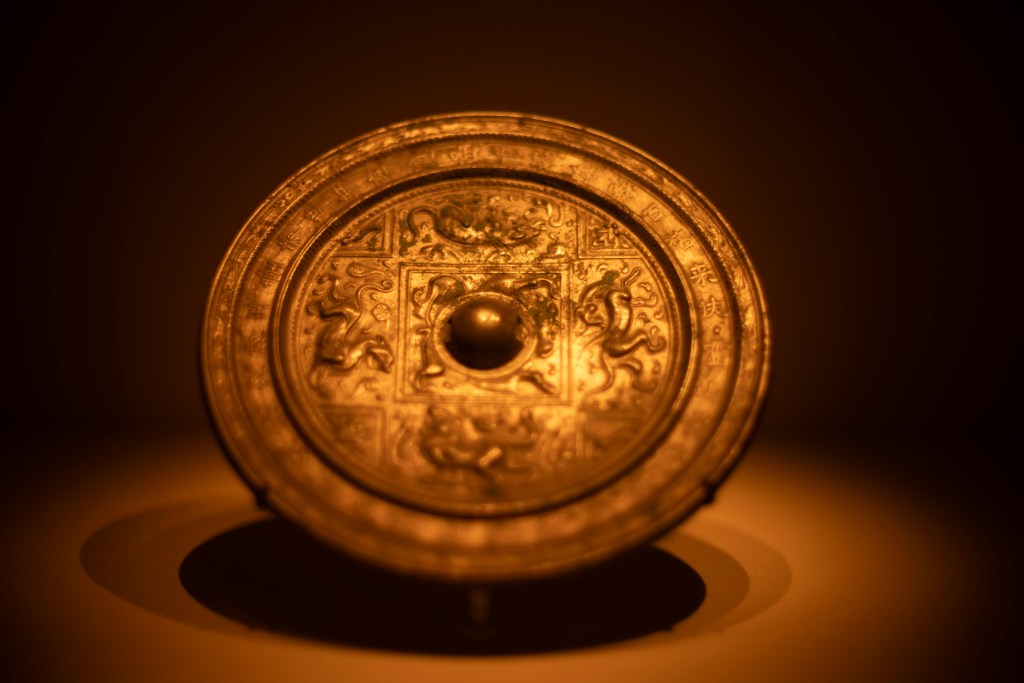
Before mirrors, people learned what they looked like from reflections in still water, from polished stone, obsidian and metal, and from what other people told them. The earliest surviving manufactured mirrors, polished obsidian discs from Anatolia, date to around 6000 BCE, while clear glass mirrors became widely affordable only after a silvering process was published in 1835. For most of history, then, a person’s mental picture of their own face was approximate, and it was shaped as much by description and portraiture as by direct sight.
Key facts
- Still water was probably the first mirror, but this is an inference because water leaves no archaeological trace.
- Polished obsidian discs from Catalhoyuk in Anatolia, dated to around 6000 BCE, are the earliest known manufactured mirrors.
- Polished copper mirrors were in use in Mesopotamia and Egypt by roughly 3000 BCE.
- Chinese bronze mirrors had a polished face and a decorated back; sources differ on when they began.
- Pliny the Elder described glass mirrors in the first century CE, but they apparently never came into general use.
- Venice ordered its glass furnaces moved to the island of Murano in 1291.
- Justus von Liebig published a chemical silvering method for glass in 1835, which made modern mirror making possible.
- The historian Ian Mortimer argues that clear glass mirrors encouraged people to think of themselves as individuals; this is an interpretation, not settled fact.
Most of us check our own faces dozens of times a day, so it is difficult to imagine a world in which that was rare. Yet for most of human history, a clear and reliable view of one’s own face was a privilege of the wealthy, and for many people it was unavailable altogether. This article follows the evidence from the first reflections in water to the mass-produced mirror, separating what archaeology and written records show from what historians reasonably infer.
How did people know what they looked like before mirrors?
The honest answer has several layers, and the earliest layer is the least documented. No ancient writer set out to explain how an ordinary person came to know their own face, so what follows combines surviving objects with careful inference.
The simplest mirror required no craftsmanship at all. Researchers generally suppose that the first reflections people studied were in still pools and in water held in a vessel (Live Science; Mirror History). This is a reasonable inference rather than a documented fact, because water leaves no trace that an excavation could recover, and a reflection in a pond is dim, unstable and easily disturbed.
Where physical evidence survives, it concerns polished surfaces: obsidian, stone and, from about the fourth millennium BCE, metal (Live Science; Discover Magazine). These objects were hand-sized and costly, so they were not a universal tool for self-knowledge.
Beyond reflections, it is reasonable to infer that people also learned about their appearance from others, through remarks, comparison with relatives and, in later periods, portraits. No source records this directly for the earliest societies, so it should be read as informed reasoning, not as evidence. The sections below take each surface in turn.
Who invented the mirror, and what were the first mirrors in history?
No single inventor can be named. The mirror emerged in different places from the same simple idea: a surface smooth enough to return an image. The earliest manufactured examples that archaeologists identify as mirrors are polished obsidian, a volcanic glass, from Catalhoyuk in central Anatolia, in modern Turkey. Hand-sized pieces from burial contexts there are dated to around 6000 BCE (Discover Magazine; Live Science), and one specialist survey calls them the earliest discernible mirrors, which leaves room for earlier examples that have not survived or been recognised (L’Antiquaire & The Connoisseur).
What is certain, and what is not
Very few of these obsidian objects are known, and they come only from the middle occupation levels of the site (Archaeology Magazine). Their purpose is not settled. The excavator’s reading was that they were used for applying make-up, but other practical and spiritual uses have been proposed, and none is confirmed (Archaeology Magazine; The Archaeologist). Some of the pieces examined had slightly convex faces and heavy scratching, which suggests handling and use, though viewing conditions in museum cases limit what can be seen (Archaeology Magazine).
Obsidian in a later world
Obsidian mirrors were not confined to the Neolithic. Aztec craftsmen in what is now Mexico made them in the sixteenth century, and the evidence suggests they were used for ritual and for scrying, not primarily for grooming. The god Tezcatlipoca, whose name means “Smoking Mirror”, is depicted with such mirrors (Live Science; National Geographic). Whether people also glanced at their faces in them is not recorded.
How did Mesopotamia, Egypt, China, Greece and Rome make ancient mirrors?
Once metalworking developed, polished metal became the standard mirror across the ancient world. The principle was the same everywhere: cast or hammer a disc, then polish one face until it reflects, and leave the other face plain or decorated.
Mesopotamia and Egypt
Small copper discs served as mirrors in Mesopotamia and north-west Iran by the late fourth millennium BCE (L’Antiquaire & The Connoisseur; Live Science). Sources vary on how early this began, so no precise start can be given. In Egypt, the oldest dated examples fall around 3000 BCE, within a range of a few centuries either side (Discover Magazine; L’Antiquaire & The Connoisseur).
Egyptian mirrors were typically a polished disc of copper or bronze fitted with a tang, a metal spike, into a handle and secured with a rivet (The Metropolitan Museum of Art; Art Institute of Chicago). Silver was considered the ideal material because of its pale lustre, though only elites could afford it (The Metropolitan Museum of Art). Mirrors turn up in burials, and most examples with a known findspot come from women’s graves, which fits the frequent association of mirrors with women in Egyptian art (The Metropolitan Museum of Art; Art Institute of Chicago).
China
Chinese bronze mirrors followed a distinctive design: a flat reflective face and a cast, decorated back with a central knob for gripping or hanging (Australian Museum; Bowers Museum). Sources differ on the origin. One museum states that bronze mirrors have been part of Chinese culture since at least the eleventh century BCE, while another reports that the earliest mirrors in the region belong to the Qijia culture, about 2200 to 1600 BCE, with Chinese-made bronze examples probably beginning before 475 BCE (Australian Museum; Bowers Museum). By the Han period the metal was a fairly consistent mix of copper, tin and a little lead, which suggests a standard recipe (Bowers Museum; Archaeological and Anthropological Sciences).
Greece and Rome
Greek mirrors were polished bronze discs, held in the hand or mounted on a stand. A bronze example from Argos, made in the middle of the fifth century BCE, shows the freestanding type and would have given the viewer the “golden sheen” of polished bronze (The Metropolitan Museum of Art, Argive mirror; The Metropolitan Museum of Art, draped-woman mirror). Greek and Roman mirrors were slightly convex discs of bronze, tin or silver, and wealthy owners sometimes had silver ones (Encyclopaedia Britannica; Discover Magazine). Mirrors large enough to show the whole body are recorded from the first century CE (Encyclopaedia Britannica; Mirror History).
Grooming tools and mirrors often traveled together. For related details on ancient grooming, see how people in Ancient Greece shaved and how people in Ancient Greece bathed.
When did glass mirrors first appear?
The Roman writer Pliny the Elder, in his Natural History, gives the first recorded reference to glass mirrors, in the first century CE. They apparently never came into general use at that time (Live Science; Discover Magazine). Glass with a metal backing begins to appear in the later twelfth and early thirteenth centuries, and from then on makers produced a sharper image than polished metal could give (Encyclopaedia Britannica; McGill Office for Science and Society).
Metal mirrors did not disappear. A hand mirror in silver or polished bronze was common across Europe by the end of the Middle Ages (Encyclopaedia Britannica), so glass and metal coexisted for a long time, and the glass versions were small and expensive at first.
Why were Venice and Murano so famous for mirror making?
Venice combined skilled glassmakers with strict control of their knowledge. In 1291 the city ordered its glass furnaces moved to the island of Murano. The stated reason was the risk of fire, though historians also point to the wish to protect trade secrets (Italy Magazine; Finestre sull’Arte). Glassmakers received privileges, but in return they were not allowed to leave Venetian territory (Finestre sull’Arte; Italy Magazine).
By the sixteenth century Venetian mirrors set the standard in Europe, and they were sold mainly to nobles and royalty (Discover Magazine; Encyclopaedia Britannica). The reflective layer was a tin-and-mercury amalgam laid against flat glass, which gave a smoother and brighter image than earlier metal coatings, and it was in place in Venice by the end of the fifteenth century (Incollect; Encyclopaedia Britannica). It was also hazardous: mercury is toxic, and the work was described as very unhealthy (Discover Magazine; SeeVenice).
The secrecy did not hold. In the seventeenth century the French minister Jean-Baptiste Colbert recruited glassworkers from Murano to break Venice’s hold on mirror glass, and sources give dates for this ranging from the 1660s to 1678 (Encyclopaedia Universalis; SeeVenice). By the middle of the century mirror making had spread to London and Paris (Encyclopaedia Britannica; Incollect).
What changed with the silvering process of 1835?
In 1835 the German chemist Justus von Liebig developed a way to deposit a thin layer of metallic silver on glass through a chemical reaction, using silver nitrate in solution (Encyclopaedia Britannica; McGill Office for Science and Society). The process was less toxic than the mercury method and, over the following decades, replaced it in industrial production (Incollect; SeeVenice).
The consequences were practical. Cheaper methods in the nineteenth century greatly increased the use of mirrors in furniture and public spaces (Encyclopaedia Britannica; Discover Magazine). For the first time, a clear and accurate image of one’s own face became part of ordinary life instead of a luxury.
How did other people’s descriptions and portraits shape self-image?
Without a reliable mirror, a person’s image of themselves was necessarily assembled from indirect sources. It is reasonable to infer that spoken descriptions mattered, along with likenesses made by artists, but few records show how individuals felt about this, so the following reflects argument and interpretation rather than proof.
The historian Ian Mortimer argues that clear glass mirrors, which appeared in Venice around 1300, changed how people saw themselves, because earlier metal mirrors were costly and gave a poor image, so most medieval people saw their own faces only dimly, in water. He links the glass mirror to a move towards individualism and to a rise in portrait commissions in the Low Countries and Italy in the fifteenth century (Kottke, on Ian Mortimer; Discover Magazine). This is one scholar’s interpretation, and the sources present it as an argument, not as settled fact.
The art itself is better documented. Early Netherlandish painters in the fifteenth century pioneered portraiture as a record of an individual’s character as well as appearance (The Metropolitan Museum of Art). It is reasonable to infer that such portraits gave sitters and their families a lasting picture of a face, which is a different thing from a private reflection, though the sources do not describe how viewers reacted.
Questions about everyday life in the distant past rarely have tidy answers, as what ancient humans did for pleasure also shows.
What does the myth of Narcissus add to the story?
The myth is best read as a cultural note, not as historical evidence of how people used mirrors. In Ovid’s Metamorphoses, Narcissus sees his reflection in a clear pool, falls in love with it, and wastes away beside the water (Theoi Project; Encyclopaedia Britannica).
The Greek traveller Pausanias offered a different version, in which Narcissus looked into the spring to recall a twin sister who had died, and he dismissed the idea that a young man could mistake his reflection for another person (Theoi Project; Encyclopaedia Britannica). The story shows that ancient writers could picture a reflection in a pool and that they treated it as striking, but it cannot show how ordinary people thought about their faces.
Frequently asked questions
Were reflections in still water really the first mirrors?
Probably, but this is an inference. Researchers suppose that pools and water in vessels came first (Live Science; Mirror History), though water leaves no archaeological record, so it cannot be proved.
What is the oldest known mirror?
The oldest known manufactured mirrors are polished obsidian pieces from Catalhoyuk in Turkey, dated to around 6000 BCE (Discover Magazine; Live Science). Earlier examples may have existed without surviving.
Did ancient metal mirrors show a clear image?
They gave a usable image, but with the tint of the metal: polished bronze has a golden sheen, and tin-rich bronze or silver looks paler (The Metropolitan Museum of Art; The Metropolitan Museum of Art). Many were also slightly convex, which slightly alters the reflection (Encyclopaedia Britannica; Archaeology Magazine).
Who invented the modern silvered glass mirror?
Justus von Liebig developed the chemical silvering method for glass in 1835, which began modern mirror making (Encyclopaedia Britannica; McGill Office for Science and Society).
Why did Venetian mirror makers keep their methods secret?
Mirrors were costly luxury goods, and Venice moved its furnaces to Murano in 1291 and restricted the movement of glassmakers to protect its craft (Italy Magazine; Finestre sull’Arte). The secrecy eventually failed as workers were recruited abroad (Encyclopaedia Universalis).
Seeing one’s own face clearly is a recent privilege, and it rests on thousands of years of polished stone, metal and glass.
Related reading: how people in Ancient Greece shaved, how people in Ancient Greece bathed and what ancient humans did for pleasure.
Sources
- Live Science: Who Invented the Mirror?
- Discover Magazine: How the Mirror Changed Humanity Forever
- Archaeology Magazine: Mirrors at Catalhoyuk
- The Archaeologist: Obsidian Mirrors at Catalhoyuk
- Mirror History: History of Mirrors
- L’Antiquaire & The Connoisseur: Origins of Mirrors
- Art Institute of Chicago: Hand Mirror, New Kingdom
- The Metropolitan Museum of Art: Silver in Ancient Egypt
- Encyclopaedia Britannica: Mirror
- The Metropolitan Museum of Art: Bronze mirror, Argive, Classical period
- The Metropolitan Museum of Art: Bronze mirror with a support in the form of a draped woman
- Australian Museum: Chinese bronze mirrors
- Bowers Museum: Reflections on Early Chinese Mirrors
- Archaeological and Anthropological Sciences (Springer): provenance study of Han dynasty bronze mirrors
- Live Science: John Dee spirit mirror came from the Aztec Empire
- National Geographic: The John Dee mirror
- McGill Office for Science and Society: How are mirrors made?
- Incollect: Fade to Black, the aging of mirror glass
- SeeVenice: Reflections on Murano glass mirrors
- Italy Magazine: A brief history of Murano glass
- Finestre sull’Arte: Brief history of Murano glass
- Encyclopaedia Universalis: Manufacture de Saint-Gobain
- Kottke.org: posts on Ian Mortimer
- The Metropolitan Museum of Art: Early Netherlandish Painting
- Encyclopaedia Britannica: Narcissus (Greek mythology)
- Theoi Project: Narkissos


Leave a Reply