
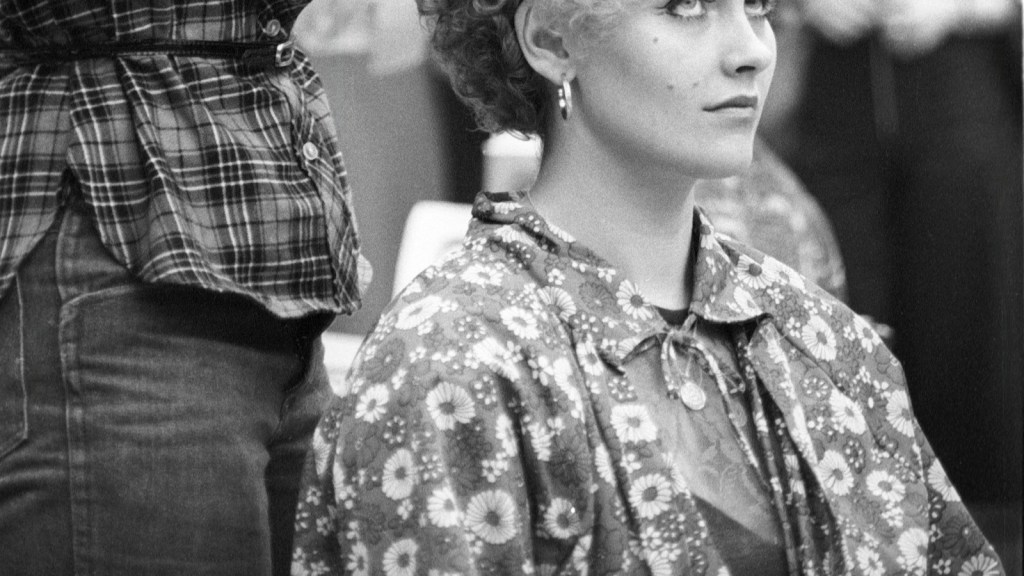
How did people style their hair in the 70s? Mostly with a round brush, a handheld dryer, rollers and a good deal of hairspray, shaping either natural texture or layered cuts that moved easily. The best-known 70s hairstyles, from the feathered flip to the shag, the wedge and the afro, shared one idea: hair should look loose and full of movement rather than set in place. This guide covers the named styles, how each was achieved, and how men and women kept them looking right. It does not repeat the question of why hair grew so long in the decade, which we cover in our article on long hair in the 70s.
How did women create the feathered flip made famous by Farrah Fawcett?
With layered cutting, a blow-dry and a set on rollers, followed by a careful comb-out. The feathered look was long, wide and layered, with the sides swept back and away from the face, and it was lighter than the shag. (Vintage Dancer, Beauty Launchpad)
Fawcett’s version became a national obsession after Charlie’s Angels debuted in September 1976, and the look peaked in 1977, according to a reference entry on the Farrah Fawcett look. That entry describes the style as flipped back, winged, layered and tousled, held in place with gel and spray.
A 1977 magazine feature reproduced by Vintage ad archive gives the routine in some detail. Her publicist said she washed her naturally curly hair each morning and arrived on set damp. A studio hairdresser then dried it with a blower, set it on electric rollers and combed it out, using hair spray lightly. The home version of the article advised layering the hair, setting the sides backward on rollers about 1.5 inches wide, and teasing the top only slightly. A modern styling guide from Woman and Home agrees on the principle: a rounded brush, hair dried in sections that curve outward, and spray to hold the shape.
Women who did not have a studio hairdresser faced a maintenance problem. The same 1977 article quotes a hairdresser saying the style needs constant combing, hot rollers or electric ironing to keep it in shape.
What was the shag haircut, and who wore it?
The shag was a layered, deliberately untidy cut worn by both men and women, with the shortest layers on top and longer lengths beneath. Two sources tie its popularity to the haircut Jane Fonda wore in the 1971 film Klute. (Beauty Launchpad, Hair and Makeup Artist)
On women, the shag could be cut short or long, with wavy or loosely curled layers. Vintage Dancer notes that the blow dryer helped the layers flip outward for volume. Woman and Home calls Stevie Nicks synonymous with the look, which it describes as many short layers around the head with a shaggy, curtain-like fringe.
On men, the same cut read as relaxed and slightly rebellious. The Fashionisto lists David Cassidy, Roger Daltrey and Paul McCartney among its wearers and describes it as a layered, textured and unstructured cut.
What was the Dorothy Hamill wedge, and which 70s hairstyles suited short hair?
The Hamill wedge was a short, angled, bowl-like cut, and it was the decade’s signature short style. Dorothy Hamill won the gold medal in figure skating at the 1976 Winter Olympics in Innsbruck, Austria, and a layered wedge cut by the stylist Yusuke Suga became a fashion craze. (Encyclopedia.com, U.S. Figure Skating)
Both sources describe the scale of the response. Women and girls went to salons and asked for the cut by her name, and Hamill appeared in advertisements for a Clairol shampoo. Encyclopedia.com adds that Life magazine named the look one of the most important fashion statements of the previous 50 years.
For readers searching for 70s hairstyles for short hair, the wedge was not the only option. The bob returned and lasted through the decade, and the pageboy, with its ends rolled under at chin or neck length, was a close relative. (Vintage Dancer, Beauty Launchpad)
What did the afro mean, and how were afros and braids styled?
The afro was both a hairstyle and a statement of Black pride. Encyclopedia.com explains that it grew out of the late 1950s and early 1960s, when some young Black women began to stop straightening their hair, and that by 1966 it was closely tied to political activism. The Smithsonian national museum of Black history and culture adds that Black Panther Party members of both sexes wore afros as a rejection of Eurocentric beauty standards, under the slogan Black Is Beautiful.
The shape itself was made by lifting unstraightened hair outward with a wide-toothed comb known as an afro pick, according to Encyclopedia.com. The same entry notes that Angela Davis, after her 1970 appearance on the FBI’s most wanted list, became closely associated with the look. History.com likewise names Davis, Diana Ross and Jimi Hendrix among those known for their afros, and describes natural hair in this period as a form of activism.
Cornrows, hair plaited flat to the scalp in rows or patterns, formed another strand of 70s hair for Black women and men. They required no relaxers or harsh chemicals. (Hair and Makeup Artist, Vintage Lifestyle) Later in the decade, Bo Derek wore the style in the 1979 film 10, a moment that History.com and Coveteur both discuss in the context of debates about cultural appropriation.
How did men style their hair in the 70s?
Men wore it longer, more layered and more blow-dried than in the previous decades, and facial hair grew with it. The Fashionisto says long hair became more acceptable as the decade went on after conservative short cuts dominated the early years, while Beauty Launchpad points to rock musicians such as the members of Led Zeppelin as influences.
Men’s 70s hairstyles included the feathered cut, swept back and away from the face, the shag, the afro, and long natural hair that was simply left to grow. Hair and Makeup Artist adds that men used tools and products once associated with women’s hairdressing to create soft layers and a fuller shape, and that many blow-dried their hair after washing instead of slicking it back with a cream. The Fashionisto agrees that blow dryers became a standard grooming tool, recommending a dryer and a round brush for volume.
Sideburns were part of the picture. Beauty Launchpad says sideburns, mustaches and beards became much more popular, and Hair and Makeup Artist and The Fashionisto both connect long sideburns with Elvis Presley and rock-and-roll culture.
What tools and products did people use to keep the styles up?
The central tool was the handheld dryer. Electric dryers had existed for decades, and hooded dryers were common in salons and homes, but Vintage ad archive explains that the looser 70s styles called for a brush and a handheld dryer instead of a rollers-and-bonnet setup. JSTOR Daily confirms that handheld models were widely preferred to hood dryers for home use.
Heat and chemistry did the rest. Hair and Makeup Artist credits heated styling tools, rollers and tongs with the flicks and wings of the decade, and describes the stack perm, in which the lower lengths of long hair were permed to give tight curls and a halo effect. Vintage Lifestyle also links perms to the bouncy curls of late-1970s disco styling. For straight hair, naturally curly women sometimes resorted to a clothes iron, a risky method noted by Vintage Dancer and Beauty Launchpad.
Fragrance was part of the routine, too. Gee, Your Hair Smells Terrific, made by the Andrew Jergens Company, was built around its scent and was launched in the 1970s. (Vintage ad archive, History Oasis)
What does this history show?
Taken together, the sources describe a decade in which hairstyles moved from rigid sets toward movement, and in which the tools that created that movement, mainly the dryer and the round brush, became everyday objects. They also show that hair carried meaning: for many Black people in the U.S. the afro and braids were declarations of identity, while for millions of others a Farrah flip or a Hamill wedge was a way of joining a shared moment. If you are curious about what came next, our article on how people did their hair in the 80s picks up the story.
David Bowie’s 1971 haircut shows how far a single cut could travel. Hairdresser Suzi Ronson cut his hair at his home in Beckenham in late 1971, a sharp departure from the long hair of most rock stars, and he appeared with the flame-red result on Top of the Pops in July 1972. (IBTimes, The Saturday Evening Post) The Post calls the cut mullet-like, but neither source claims it created the mullet.
What was left out, and why?
We left out any claim that a specific person invented the wedge, the shag or the Farrah cut, because sources disagree or name only one person. We also left out the origin of the mullet, brand claims for Aqua Net and Dep, the date of Gee, Your Hair Smells Terrific, the use of headbands and scarves, and the weekly salon set, because we could not confirm each with two independent sources.
Frequently asked questions
What were the most popular 70s hairstyles for women?
The feathered flip, the shag, the Dorothy Hamill wedge, the afro, long straight hair, and soft permed curls were all prominent. Bobs and pageboys also continued throughout the decade.
What were the most popular 70s hairstyles for men?
Men wore long natural hair, feathered cuts, shags and afros, often with sideburns or a mustache. Many also blow-dried their hair, which helped shape the layers.
How did people get the feathered look at home?
They layered the hair, blow-dried it with a round brush, set it on rollers, then combed it out and held it with spray. Women with naturally curly hair sometimes ironed or blow-dried it first.
Were the afro and braids only fashion?
No. The afro and cornrows had deep cultural meaning, and sources describe natural hair in this period as a form of activism and pride, though the afro spread widely as fashion later.
If you enjoy history like this, browse more in our History and Facts sections and subscribe to Mr Global Rankss on YouTube (https://www.youtube.com/@mrglobalrankss) for more science, history and rankings.
Related reading: How Did People Have Such Long Hair in the 70s? | How Did People in the 80s Do Their Hair?
Sources
- Vintage Dancer: 1970s hairstyles for women
- Hair and Makeup Artist: women's 1970s hairstyles
- Hair and Makeup Artist: men's 1970s hairstyles
- Beauty Launchpad: 9 iconic 1970s hairstyles
- Woman and Home: best 70s hairstyles
- Encyclopedia.com: Dorothy Hamill
- U.S. Figure Skating: Hamill Olympic performance
- Encyclopedia.com: Afro hairstyle
- Smithsonian national museum of Black history and culture: Black Panther Party uniform
- Vintage ad archive: how to get Farrah Fawcett hair
- Encyclopedia.com: Farrah Fawcett look
- Vintage ad archive: Gee, Your Hair Smells Terrific
- History Oasis: discontinued hair products
- IBTimes: story behind the Ziggy Stardust haircut
- The Saturday Evening Post: Ziggy Stardust at 50
- Vintage Lifestyle: 1970s hair trends
- The Fashionisto: 70s men's haircuts
- Vintage ad archive: home hair dryers 1960s-1970s
- JSTOR Daily: a short history of hairdryers
- History.com: Black hairstyles visual history
- Coveteur: the history of the cornrow


Leave a Reply