
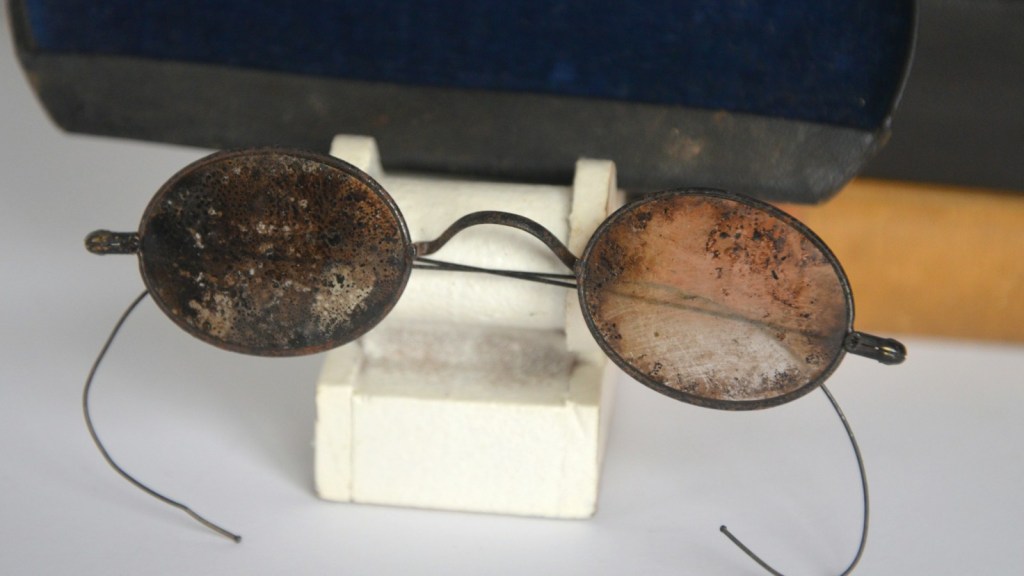
How did people see before glasses? For most of history they managed with what the body and simple tools allowed: squinting to sharpen a blurred view, reading in strong daylight, and, from around the year 1000, laying a curved piece of crystal or glass over a page. Wearable spectacles appeared in northern and central Italy only in the late 1200s, according to Encyclopedia.com and Wikipedia’s history of glasses. Before that, anyone whose near vision faded in middle age faced a practical problem, because a reader, a scribe or a craftsman depended on clear sight at arm’s length. This article follows the evidence from improvised remedies to the first pairs of spectacles, and it marks the points on which scholars still disagree.
How did people with poor eyesight cope before glasses?
They relied above all on squinting. Narrowing the eyelids shrinks the opening through which light enters, and All About Vision explains that a smaller effective pupil produces less blur from nearsightedness, astigmatism and presbyopia. A physics paper on pinhole glasses reaches the same conclusion: a small aperture shrinks the blurred circles on the retina without correcting the eye itself. The method has limits, since both sources note that it dims the image and is far less sharp than a lens.
The need was widespread because of ordinary ageing. The Mayo Clinic reports that presbyopia, the stiffening of the eye’s lens, usually begins after age 40 and that nearly everyone develops blurred near vision at some point afterward. Wikipedia’s entry on presbyopia estimates that about 25 percent of people worldwide, roughly 1.8 billion, were affected as of 2015. No reliable figures exist for earlier centuries, so any historical percentage would be a guess. What can be said is that every literate community included older readers who could no longer see small letters clearly.
What did ancient people think caused vision?
Many of them believed that the eye sends something out. According to Wikipedia’s article on the Book of Optics and Muslim Heritage, Euclid and Ptolemy held an extramission view, in which rays leave the eye and reach the object, while Galen and the followers of Aristotle leaned toward the opposite idea that something travels from the object into the eye.
The scholar Ibn al-Haytham, known in Europe as Alhazen, rejected extramission in his Book of Optics, written between about 1011 and 1021. He argued that vision depends on light entering the eye, and both sources describe his model as the basis of the later accepted theory. Scholars qualify the picture, however. An article in Europhysics News notes that he did not originate the law of refraction, which Ibn Sahl had described earlier, and that other writers such as al-Kindi also contributed. Dates for the Latin translation also vary, from the twelfth century in that article to 1240 in the ZEISS history and 1266 in Encyclopedia.com. This article does not choose between them.
Did the ancient world have lenses?
It had pieces of shaped glass and crystal, but there is no clear evidence of lenses worn to correct sight. The Ophthalmologist states that no definite proof exists for vision-correcting spectacles in antiquity, and it says that Greeks used water-filled glass balls as magnifiers by the first century BC.
Several famous stories are less certain than they sound. Encyclopedia.com and Ancient Pages both repeat the report that the Roman philosopher Seneca enlarged letters by reading through a glass globe of water, yet both attribute it to ancient sources and neither offers confirmation. The emperor Nero is said to have watched gladiators through a green stone. Wikipedia ties this to an emerald mentioned by Pliny the Elder, ZEISS calls it a green stone, and The Ophthalmologist says it is unclear whether he used it for his sight at all. The Nimrud lens is similarly debated. Science Times describes the polished rock crystal from an Assyrian palace as a possible magnifier, burning glass or furniture inlay, and Encyclopedia.com calls a rock crystal lens from Nineveh the oldest known lens. Its purpose remains disputed, and this article takes no side. For a related glimpse of Roman habits, see What Did People in Ancient Rome Actually Do All Day?.
What were reading stones?
A reading stone was a rounded, lens-like piece of transparent material placed flat on a page to enlarge the letters beneath it. Wikipedia dates regular use to around the year 1000 and calls them among the earliest common uses of lenses, while Ancient Pages also places their development around 1000 AD and links them to monks with failing sight.
Sources differ on the material. Wikipedia names rock crystal, beryl and glass, ZEISS describes semi-spherical lenses of rock crystal or quartz, All About Vision mentions beryl or crystal and later soft glass, and Encyclopedia.com describes segments of glass spheres. The honest summary is that several materials were used. Quartz objects found in Viking graves on Gotland, in Sweden, may have been reading stones, according to Wikipedia and Daily Medieval, though the latter notes that several are poorly shaped for focusing.
When and where were the first eyeglasses made?
The best-supported answer is central Italy in the late 1280s or 1290s, with no named inventor. Wikipedia places the first glasses probably in Pisa or Florence by about 1290, Ancient Pages says Pisa between about 1285 and 1289, and The Ophthalmologist favors Pisa around 1286. Encyclopedia.com adds that historians disagree on whether Florence or Pisa has the stronger claim.
The key document is a sermon by the Dominican friar Giordano da Pisa, also called Giordano da Rivalto, preached in Florence in 1305 or 1306 according to All About Vision, Daily Medieval and Wikipedia. He said that the art of making eyeglasses was less than twenty years old and that he had spoken with the person who first practiced it. A fellow friar, Alessandro della Spina, is recorded as making glasses and sharing the craft freely. Salvino degli Armati of Florence is sometimes named as the inventor, but Wikipedia and The Ophthalmologist both describe that claim as unsupported. Venice regulated the sale of glass lenses for the eyes by 1301, as noted by Encyclopedia.com and Wikipedia.
Who wore the first spectacles, and what did they look like?
The earliest pairs were two convex lenses set in rims of bone, metal or leather and joined by a central rivet, and they were held before the eyes or pinched onto the nose. The Ransom Center and ZEISS both describe this design, and Encyclopedia.com notes that it had no side arms. These convex lenses suited older readers, not nearsighted people.
Early images link spectacles with scholars and clergy. Tommaso da Modena’s fresco of 1352 in Treviso, which shows a cardinal reading with spectacles, is cited by Wikipedia, ZEISS and the Ransom Center. The last of these adds that Saint Jerome is often painted wearing them. By the late fifteenth century the market had widened: the Ransom Center reports that England imported them by the thousands, and Encyclopedia.com says that use had spread enough for artists to employ them as symbols of folly. The same period of rapid change in everyday objects is explored in How Did People Know What They Looked Like Before Mirrors?.
When did spectacles gain ear hooks and other styles?
The modern frame with arms resting on the ears took shape in the early 1700s. Wikipedia says it existed before 1727 and credits the London optician Edward Scarlett as a possible originator, and ZEISS cites a Scarlett brochure of 1728 showing temple glasses. All About Vision is more cautious, stating that no single inventor is documented and that arms were added during the first half of the century. The year, then, is 1727 or 1728 depending on the source, and the inventor is unproven.
Nose-pinching styles did not disappear. Wikipedia’s article on the pince-nez says that modern versions appeared in the 1840s and peaked between about 1880 and 1900, and ZEISS dates the pince-nez as a status symbol in 1841. Both sources agree that the style relied on spring tension and could slip off the nose.
Did Benjamin Franklin really invent bifocals?
Probably not alone, and perhaps not at all. FactMyth reports that in an August 1784 letter to George Whatley Franklin wrote that he was happy in the invention of double spectacles, and in 1785 he described cutting two lenses in half and fitting the halves in one frame, yet he never plainly claimed to be the inventor. Wikipedia’s bifocals article quotes the College of Optometrists as concluding that Franklin was one of the first to wear split bifocals, adding that London opticians may already have known the design.
Other sources simply repeat the popular credit: ZEISS and All About Vision both date Franklin’s bifocals to 1784. Because the two accounts conflict, this article presents Franklin as an early and famous user whose role as inventor is unresolved.
What does this history show?
The history shows that correcting poor eyesight was a slow accumulation of small ideas, not a single invention. Squinting offered a free but limited remedy, reading stones turned a lens into a reading tool, and spectacles at last freed the hands. The people who benefited first were older readers and scholars, whose work depended on near vision, and the surviving evidence tells us far less about ordinary workers who simply went without.
What was left out, and why?
Several popular claims appeared in only one opened source or conflicted with others and are therefore omitted: the date and measurements of the Nimrud lens, the story that Cicero had slaves read aloud, Petrarch’s remarks about spectacles, the monocle’s history, the Strasbourg spectacle shop of 1466, claims about Chinese or Arab origins, and reports that concave lenses for nearsightedness appeared in 1462 or in the 1500s. Working by daylight and memorizing texts are plausible habits, but no pair of sources confirmed them.
Frequently asked questions
How did people see before glasses?
They squinted to sharpen their view, read in good light, and from about the year 1000 used reading stones, which were curved pieces of crystal or glass placed on the page.
Who invented the first eyeglasses?
No one knows. Italian records point to Pisa or Florence around the late 1280s or 1290s, and the unnamed maker was mentioned in a friar’s sermon in 1305 or 1306.
What was a reading stone?
It was a rounded lens-like piece of rock crystal, beryl or glass laid on a page to enlarge text, mainly used by people with failing near vision.
When did glasses get arms for the ears?
Sources place the ear-hooking frame in the early 1700s, with a London optician named Edward Scarlett often mentioned in connection with 1727 or 1728.
If you enjoy history like this, browse more in our History and Facts sections and subscribe to Mr Global Rankss on YouTube (https://www.youtube.com/@mrglobalrankss) for more science, history and rankings.
Related reading: How Did People Know What They Looked Like Before Mirrors?, What Did People in Ancient Rome Actually Do All Day?, How People Heated Their Homes in the 1700s
Sources
- Encyclopedia.com: The Invention of Spectacles
- All About Vision: A history of glasses
- Wikipedia: Reading stone
- Wikipedia: Glasses
- ZEISS: The history of glasses
- Daily Medieval: Eyeglasses
- The Ophthalmologist: Time Machine chapter 36
- Science Times: Nimrud lens
- FactMyth: Franklin and bifocals
- Wikipedia: Bifocals
- Wikipedia: Book of Optics
- All About Vision: Why do we squint
- Kansas State physics paper: pinhole glasses
- Wikipedia: Presbyopia
- Mayo Clinic: Presbyopia causes
- Ancient Pages: History of eyeglasses
- Ransom Center Magazine: Medieval spectacles
- Europhysics News: Optics and Arabic science
- Muslim Heritage: Ibn al-Haytham, eye and brain
- Wikipedia: Pince-nez


Leave a Reply