
Why is Buffalo wings sauce called Buffalo, when the dish contains no buffalo at all? The short answer: the name comes from Buffalo, New York, the city where this style of chicken wing was created, and it has nothing to do with the animal. The best-known account traces the first plate to the Anchor Bar in 1964, when Teressa Bellissimo fried chicken wings and coated them in hot sauce, but the full history is more contested than the legend suggests. This article explains where the name Buffalo wings originated, how Buffalo wings were invented, who else claims the credit, what the sauce is made of, and why the word Buffalo now appears on menus far beyond chicken. Every claim below was checked against at least two independent sources.
Is Buffalo sauce named after the animal or the city?
It is named after the city. The Encyclopaedia Britannica states that the name comes from Buffalo, New York, where the dish was created, and Wikipedia adds that the name has no connection to the bison. Today I Found Out makes the same point plainly: the wings take their name from the city in western New York, not from the animal.
That answers one of the most common versions of the question: why is it called Buffalo wings when it’s chicken? The word Buffalo describes where the recipe came from, not what is in it. A Buffalo wing is a chicken wing prepared in the style that developed in the bars of that city, and the label stayed with the dish as it spread. The Encyclopaedia Britannica notes that the same food is also known as chicken wings, hot wings or simply wings, and Wikipedia treats hot wing as another name for the Buffalo wing.

How were Buffalo wings invented?
The most widely repeated answer points to the Anchor Bar, a Buffalo restaurant owned by Frank and Teressa Bellissimo. The Buffalo History Museum, Buffalo Toronto Public Media and Wikipedia all date the first Anchor Bar wings to 1964 and credit Teressa Bellissimo with preparing them. FOX 5 New York likewise reports that the Anchor Bar is largely credited with creating the modern Buffalo wing in 1964, while noting that other local restaurateurs have challenged the claim.
The details of that night depend on who tells the story. In one version, the couple’s son Dominic was tending bar late at night when hungry friends arrived, and his mother fried chicken wings and tossed them in hot sauce as a quick snack. Wikipedia records this account, and Buffalo Toronto Public Media describes Dominic running the bar with regulars late one night when they grew hungry. A second version, which Dominic gave to the writer Calvin Trillin for The New Yorker in 1980, holds that it was a Friday and that he wanted to offer something to mostly Catholic customers who could eat meat again once midnight arrived; Buffalo Toronto Public Media, Today I Found Out and Wikipedia all report it. A third account, attributed to Frank Bellissimo, says the bar received a delivery of wings by mistake instead of the backs and necks it normally used for spaghetti sauce, and that Teressa found a better use for them. Buffalo Toronto Public Media, Today I Found Out and Wikipedia each describe that mistaken delivery.
The preparation, by contrast, is consistent across the accounts. The wings were cut in half, deep-fried without breading, coated in hot sauce and served with celery and blue cheese dressing, according to the Buffalo History Museum, Buffalo Toronto Public Media and Today I Found Out.
Historians treat the 1964 story with some caution. Both Today I Found Out and Wikipedia point out that a 1969 newspaper feature about the Anchor Bar made no mention of chicken wings, which is one reason the date is not regarded as settled. The Buffalo History Museum also declines to name a single inventor, observing that the city’s affection for wings is not limited to the Bellissimo version.
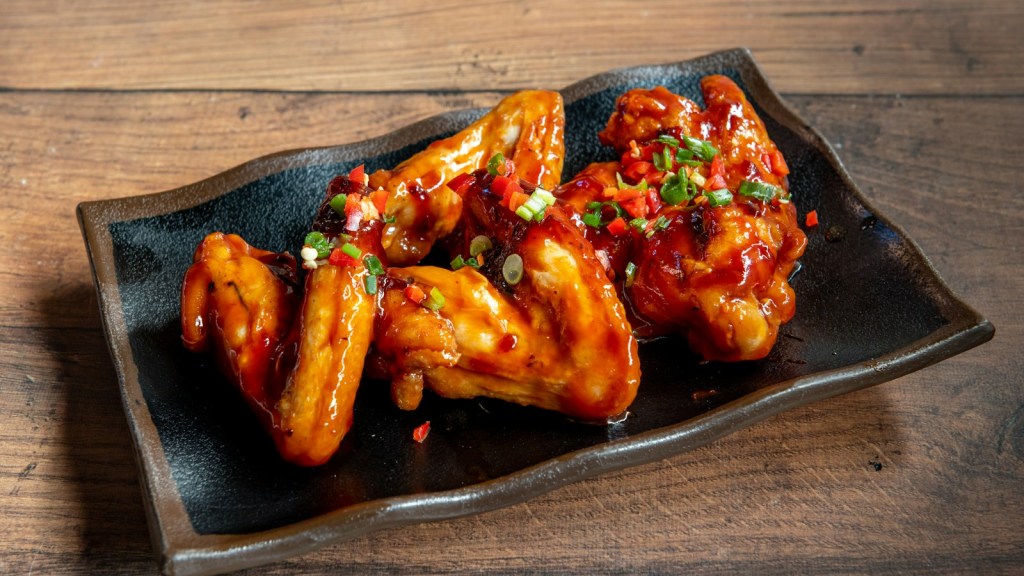
Who else claims to have invented Buffalo wings?
The best-documented rival claim belongs to John Young, a Buffalo restaurateur who sold wings at his own restaurant during the 1960s. The Buffalo History Museum and Buffalo Toronto Public Media both place his business on Jefferson Avenue. Buffalo Toronto Public Media and Wikipedia give its name as Wings ‘n Things, while the Buffalo History Museum spells it Wings & Things.
Young’s wings were a different dish. He served them whole rather than cut in half, coated them in breading, and finished them with a tomato-based sauce he called mambo sauce, a description shared by the Buffalo History Museum, Buffalo Toronto Public Media and Wikipedia. The Anchor Bar wing, by contrast, was unbreaded, split into pieces and dressed in hot sauce and butter. In effect, the two kitchens produced two distinct Buffalo sauce styles, and only the Anchor Bar style became the template copied across the U.S. and beyond.
Young’s limited recognition is also part of the story. Buffalo Toronto Public Media notes that his wings were popular on Buffalo’s East Side but were largely ignored by the rest of what was then a segregated city, and Today I Found Out reports that some observers believed race played a part in his being overlooked. The exact year he began selling wings is uncertain because the sources disagree, but all of them place it in the 1960s.
The city’s official position leaned toward the Bellissimos. In 1977, Buffalo mayor Stan Makowski proclaimed July 29 as Chicken Wing Day, according to Today I Found Out and FOX 5 New York. Wikipedia, citing The New York Times, reports that the proclamation honored Anchor Bar co-owner Frank Bellissimo, and Today I Found Out observes that it credited the family without offering real evidence of who came first. The date is still observed as National Chicken Wing Day, as both FOX 5 New York and Today I Found Out note.
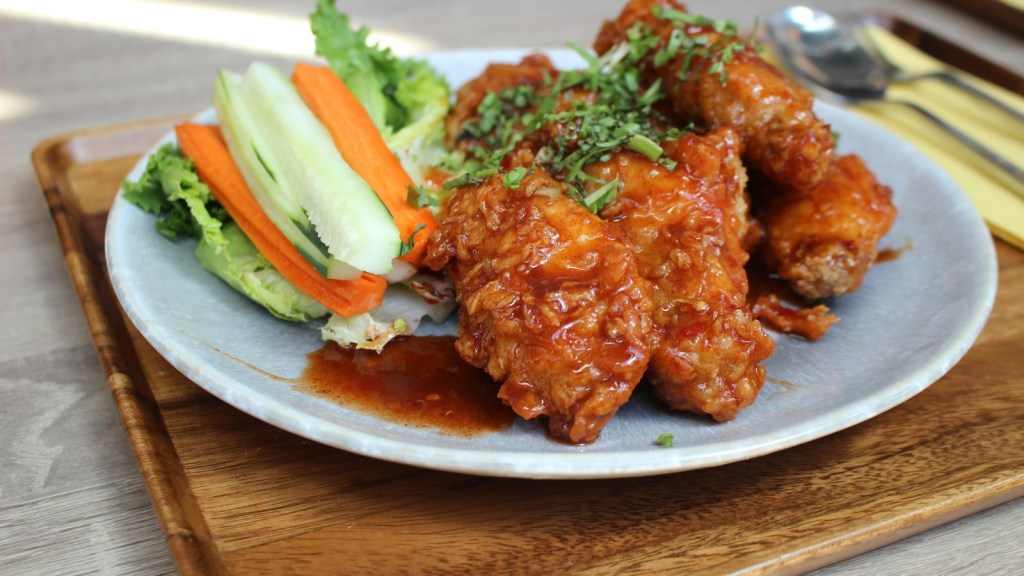
What is Buffalo wings sauce made of?
At its core, Buffalo sauce combines two ingredients: a cayenne pepper hot sauce and butter. The Encyclopaedia Britannica describes the coating as a vinegar-and-cayenne-pepper hot sauce mixed with butter, and Wikipedia gives the same basic formula of cayenne pepper hot sauce and melted butter. Today I Found Out describes the Anchor Bar’s original mixture as hot sauce combined with melted butter and cayenne pepper.
The hot sauce most closely tied to the dish is Frank’s RedHot. Buffalo Toronto Public Media names it as the sauce used at the Anchor Bar, and Wikipedia identifies it as the traditional choice while noting that similar sauces are also used. Restaurants commonly offer the wings in milder and hotter versions, as both the Encyclopaedia Britannica and Wikipedia note.
The wing itself is traditionally deep-fried without breading or flour before it is sauced, according to the Encyclopaedia Britannica and Wikipedia. That bare, crisp surface is the clearest physical difference between the Anchor Bar style and the breaded wings associated with John Young.
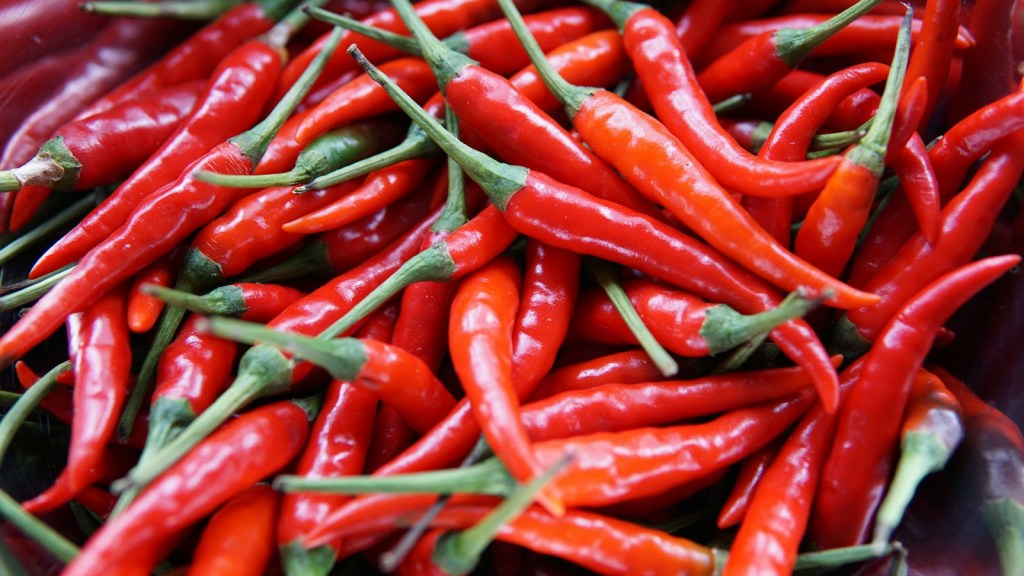
Why are Buffalo wings served with celery and blue cheese?
Celery sticks and blue cheese dressing belong to the dish’s earliest recorded form. The Buffalo History Museum, Buffalo Toronto Public Media and Today I Found Out all describe the original Anchor Bar wings as arriving with celery and blue cheese on the side, and the Encyclopaedia Britannica and Wikipedia list the same accompaniments as the traditional way to serve Buffalo wings today.
None of the sources consulted explains with certainty why those two items were chosen. What the record does show is that the pairing became fixed early and traveled with the dish as it spread, and the two remain the standard companions to the wings today.
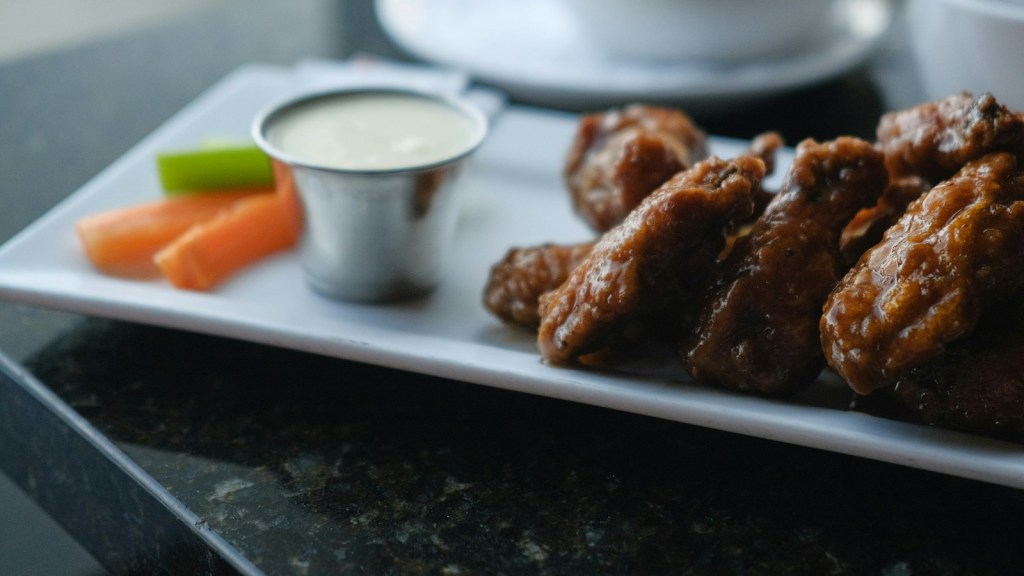
Why did Buffalo become a flavor name for other foods?
Once the dish spread beyond western New York, the word Buffalo began to stand for a flavor rather than a place. Wikipedia reports that Buffalo wings became a common bar food and appetizer across the U.S. and in nearby Canadian towns during the 1970s and 1980s, and Buffalo Toronto Public Media describes the Anchor Bar’s version spreading through the city’s bars and then across the continent and overseas.
As the flavor became familiar, the name moved onto other foods. Today I Found Out explains that Buffalo now describes the sauce on dishes such as Buffalo shrimp and Buffalo pizza, and that it refers to a style of sauce rather than any ingredient from the animal. Wikipedia lists boneless wings, chicken nuggets, popcorn chicken, shrimp and cauliflower among the foods now sold under the Buffalo name. This is why a dish with no meat at all can be called Buffalo cauliflower: the word signals the cayenne and butter flavor, not the protein.
Food names often carry histories that have little to do with the ingredients, and food rules can be just as surprising. Our articles on why haggis is banned in the U.S. and why the U.S. banned sliced bread in 1943 look at two more unexpected chapters in food history.
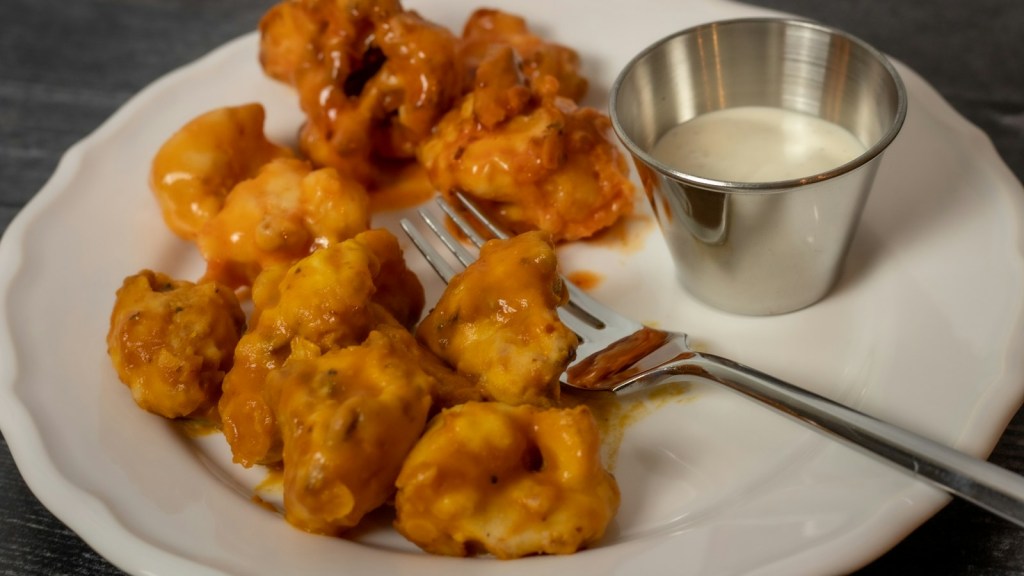
Why is Buffalo known for wings?
Taken together, the evidence makes the naming question simple even though the origin story is not. The word Buffalo identifies the city where this style of wing took shape. The Anchor Bar and the Bellissimo family hold the most widely accepted claim, reinforced by the 1977 city proclamation and decades of retelling, yet historians have noted gaps in the record and a credible rival tradition in John Young’s breaded wings and mambo sauce. Buffalo is known for wings because both stories, and the many restaurants that followed them, belong to the same city.
For more surprising origins behind ordinary things, see our collection of weird facts about everyday things.
What was left out, and why?
Several details were left out because only one source supported them or because the sources disagreed. Buffalo Toronto Public Media reports that a Buffalo News food critic found Anchor Bar newspaper advertisements from 1963 mentioning fried chicken wings, which would predate the 1964 story, but no second source we read confirmed it. The Buffalo History Museum cites an 1857 hotel menu in Buffalo that listed fried chicken wings; that is also single-sourced here. The year John Young began selling wings is given as 1961, 1963, 1966 and the mid-1960s by different sources, and the year he left Buffalo also differs, which is why only the decade is stated. One cooking publication we read suggests Young was friends with Frank Bellissimo and that the idea may have passed between them; no second source supported this. Claims that appeared only on Wikipedia, such as the 1969 start date for the Buffalo restaurant Duff’s, Young’s 2013 induction into a wing festival hall of fame, and the national pizza chains that added wings in the 1990s, were also omitted. Britannica’s remark that blue cheese helps cool the mouth, the origin of mambo sauce outside Buffalo, and the history of the city’s own name were each found in only one source.
Frequently asked questions
Why is it called Buffalo wings when it’s chicken?
The word Buffalo refers to Buffalo, New York, where this style of chicken wing was created, not to the animal. Encyclopaedia Britannica and Wikipedia both explain that the name identifies the city of origin, and Buffalo has since become shorthand for the cayenne and butter sauce.
What are Buffalo wings named after?
They are named after the city of Buffalo, New York. The most widely cited origin is the Anchor Bar, where Teressa Bellissimo is credited with first serving the wings in 1964, although the date and the inventor are still debated.
How were Buffalo wings invented?
According to the best-known account, Teressa Bellissimo cut chicken wings in half, deep-fried them, coated them in hot sauce and served them with celery and blue cheese at the Anchor Bar. The stories differ on why: a late-night snack for her son Dominic and his friends, a Friday midnight treat for customers, or a mistaken delivery of wings.
Why are hot wings called Buffalo wings?
Hot wings and Buffalo wings are commonly used as names for the same spicy chicken wing. The Buffalo label comes from the city where the dish began, while hot describes the cayenne pepper sauce that coats it.
Why is Buffalo known for wings?
Buffalo is where the dish took shape in the 1960s, at the Anchor Bar and at John Young’s restaurant, which served a breaded wing with a tomato-based mambo sauce. In 1977 the city proclaimed July 29 as Chicken Wing Day, and the date is still observed as National Chicken Wing Day.
If you enjoy the stories behind familiar foods and everyday names, browse more in our Facts and History sections and subscribe to Mr Global Rankss on YouTube (https://www.youtube.com/@mrglobalrankss) for more history, facts and rankings.
Related reading: Why Is Haggis Banned in the U.S.?, Why Did the U.S. Ban Sliced Bread in 1943?, Everyday Facts You Didn’t Know: Weird Facts About Everyday Things
Sources
- Buffalo History Museum: Who served Buffalo's first wings?
- Buffalo Toronto Public Media (Niagara Frontier Heritage Project): The night they invented chicken wings
- Today I Found Out: Why Buffalo wings are called that
- Wikipedia: Buffalo wing
- Encyclopaedia Britannica: Buffalo wing
- FOX 5 New York: National Chicken Wing Day, the backstory behind the holiday


Leave a Reply