
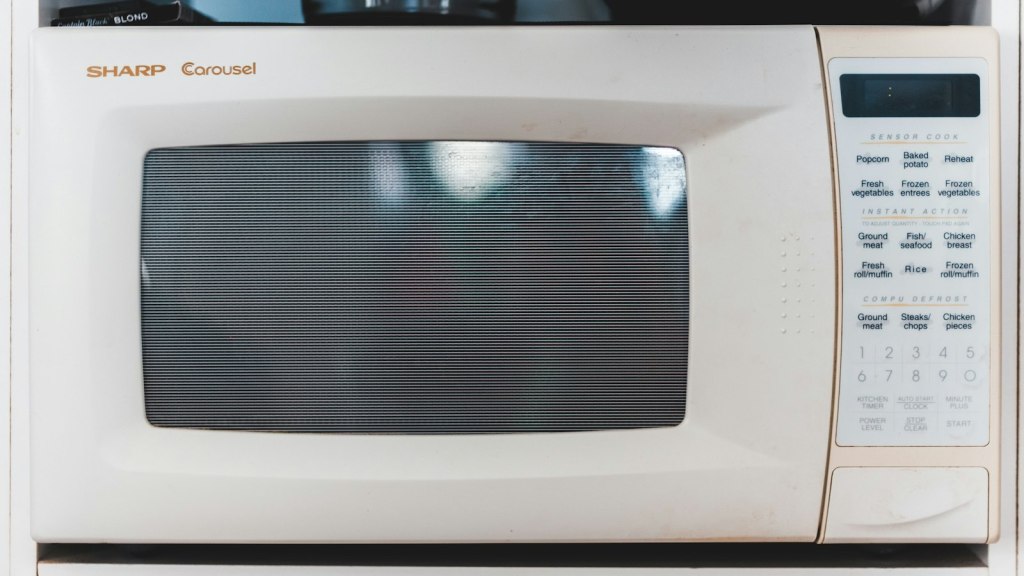
How does a microwave heat food without getting hot? A microwave oven does not heat its interior the way a conventional oven does. A part called a magnetron produces microwaves at about 2.45 gigahertz, water, fats and sugars in the food absorb that energy and turn it into heat, and the metal walls reflect the waves, which keeps the air inside close to room temperature. That short answer is the core of how does a microwave work, and the details explain several everyday puzzles, from cold spots to sparks.
This article follows the process step by step, covers the microwave physics behind it, and explains why microwaves heat food unevenly, why dishes usually stay cooler than the meal, what a turntable or a metal rack changes, and what the research says about radiation and safety.
How does a microwave work, step by step?
The sequence has four stages. First, the oven draws ordinary mains electricity. Second, the magnetron converts that electricity into microwaves. Third, the waves travel along a metal channel called a waveguide into the cooking chamber. Fourth, the food absorbs the waves and warms up. According to Explain that Stuff, the magnetron turns mains electricity into microwaves that are channeled through a waveguide into the food compartment, and Encyclopaedia Britannica describes the magnetron as an electron tube that produces radiation at roughly 2,450 megahertz.
A frequency of 2.45 gigahertz means the electric field in the oven reverses 2.45 billion times every second. ScienceABC and physicist Michael Vollmer’s 2004 paper in Physics Education both give this as the operating frequency of home ovens. Microwaves sit between radio waves and infrared light on the electromagnetic spectrum, a placement described by HowStuffWorks and consistent with the radio-type waves compared with television and radar signals by the U.S. Department of Agriculture’s Food Safety and Inspection Service.
Why does the oven stay cool while the food gets hot?
The reason is that the heat is produced inside the food rather than in the oven. Britannica states that the vibrations of water, fat and sugar molecules generate heat in the food itself and not in the surrounding air, and HowStuffWorks adds that the air in the oven stays near room temperature. A conventional oven works the opposite way: it heats the air and the walls first, and the food gains heat from them.
The cooking chamber is also a sealed metal box. Explain that Stuff says the metal walls reflect microwaves much as a mirror reflects light, and Vollmer likens the reflection to that of a silver mirror. Because the walls bounce the waves back toward the food instead of absorbing them, the chamber itself is not what warms up. This is a different kind of heat flow from the one described in our article on why desert people wear more clothes in extreme heat, where heat arrives from the surrounding air and sun.
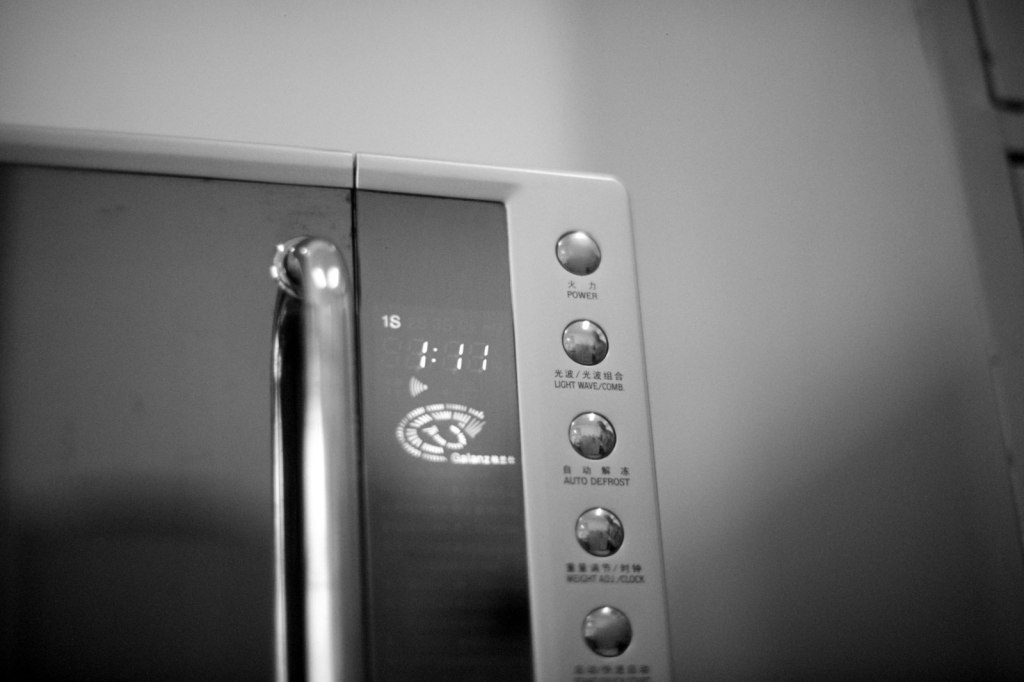
What do microwaves do to water molecules?
This is the heart of the microwave physics, and it is called dielectric heating. A water molecule is polar, meaning one end carries a slight positive charge and the other a slight negative charge. According to the University of Southern California’s Illumin engineering magazine, such molecules turn to line up with an electric field, and when the field reverses more than a billion times per second they spin back and forth, producing heat through friction with their neighbors. Vollmer explains the same effect as dielectric loss: at 2.45 gigahertz the molecules lag behind the oscillating field and absorb energy as they do so.
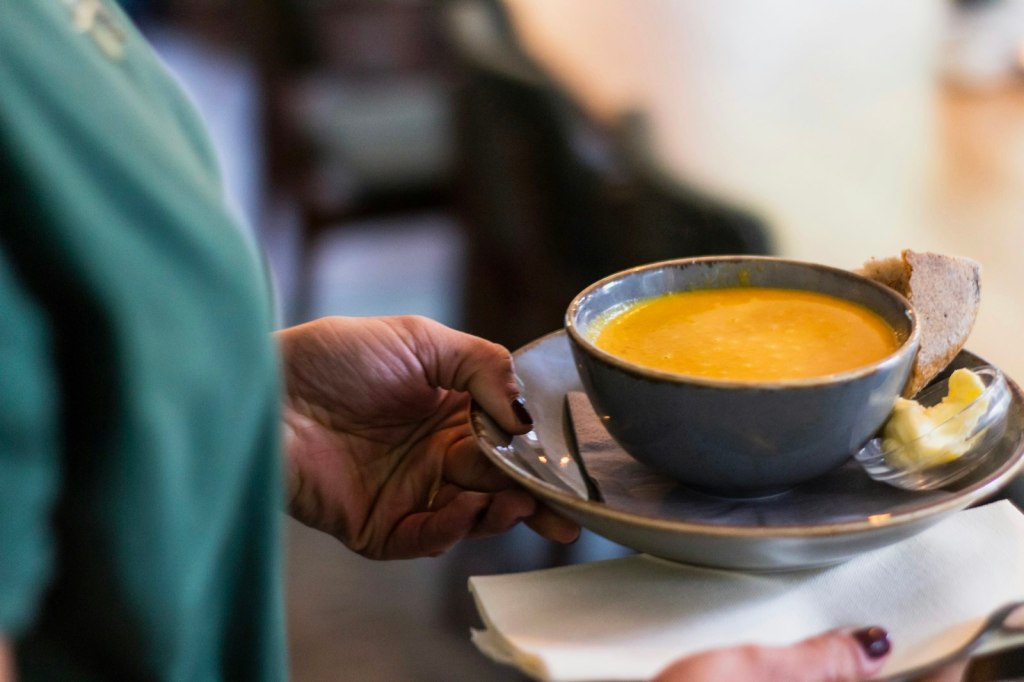
Water is not the only absorber. Britannica and HowStuffWorks both list fats and sugars alongside water as molecules that absorb microwaves and convert the energy to heat. This is why moist foods such as soup tend to heat faster than drier ones.
Why does a microwave heat food unevenly?
There are two separate causes. The first is the wave pattern inside the oven. Microwaves reflect off the metal walls and interfere with one another, forming standing waves. ScienceABC reports that the wavelength is about 12 centimeters (4.7 inches), that constructive interference creates hot spots and destructive interference creates cold spots, and that these occur roughly every 6 centimeters (2.4 inches), which is half the wavelength. Vollmer gives the wavelength as 12.23 centimeters and notes that infrared imaging of an empty oven shows a clear pattern of strong and weak regions.
The second cause is how deeply the energy reaches. Britannica explains that moist outer layers can absorb most of the radiation before it reaches the interior, and the Health Physics Society says that in thick foods the outer layers absorb most of the microwaves and heat then conducts slowly inward. That is why a frozen dinner can be scalding at the edge and cool in the center, the pattern that people search for as why a microwave heats unevenly. Moister parts also heat faster than drier parts, according to Britannica and Explain that Stuff.
Uneven heating is a food-safety matter as well as an annoyance. The Food Safety and Inspection Service and Clemson University’s Home and Garden Information Center both warn that cold spots can let harmful bacteria survive, and both recommend stirring or rotating food during cooking. Both also advise checking several spots with a food thermometer: 165 degrees Fahrenheit (74 degrees Celsius) for poultry and 160 degrees Fahrenheit (71 degrees Celsius) for ground meat. The food safety angle also appears in our article on what happens to unsold cruise ship food.
What does a turntable do, and what if there is no turntable?
A turntable moves the food through the hot and cold spots, which prevents any area from sitting in one position for the whole cycle. ScienceABC and Vollmer agree on this point, and both add that some ovens skip the turntable and instead use a rotating reflector, called a mode stirrer, to scramble the wave pattern. An oven built around a turntable should not be run without one, because the food would then sit in a fixed pattern of strong and weak regions.
The turntable is not a complete fix. The Food Safety and Inspection Service states that a turntable does not replace stirring, rotating or flipping the food partway through. It also recommends letting food stand for at least 3 minutes, and Clemson recommends several minutes, because heat keeps spreading and finishes the cooking after the power stops.
Why do containers stay cooler, and what about metal?
Most dishes do not absorb microwaves. Britannica says most glass, foam, polyethylene and paper pass the waves without absorbing them, and HowStuffWorks says the same of most plastics, glass and ceramics, and these containers therefore usually stay cooler than the meal. They can still warm by contact with hot food, as Explain that Stuff notes for plastic and paper, and Clemson advises using potholders to remove dishes. A dish that heats up when empty is a warning sign: both Clemson and the Food Safety and Inspection Service describe a test in which the dish and a cup of water run for 1 minute on high, and a warm dish should not be used.
Metal behaves very differently. The Food Safety and Inspection Service explains that microwaves cannot pass through metal, and food fully wrapped in foil will not heat, and that metal can cause arcing, meaning sparks. Britannica adds that aluminum foil can heat rapidly and may ignite a fire under some conditions. As for a metal rack, Clemson says to avoid metal pans and foil containers unless the manufacturer specifically approves them, and the Food Safety and Inspection Service says that if an oven has a metal turntable or shelves, foil containers and metal pans should not be used with them. In practice, the manual is the authority on any rack that came with the oven.
Is microwave radiation safe?
The word radiation sounds alarming, but the type matters. The Food Safety and Inspection Service calls microwaves non-ionizing and notes that they do not make food radioactive, and the Health Physics Society describes them as less energetic than x rays. Once the oven stops producing microwaves, no radiation remains, which the Oregon Health Authority compares to a light turning off.
Federal rules also limit leakage. The Oregon Health Authority and the Health Physics Society both report that ovens made after October 1971 must keep leakage at or below 5 milliwatts per square centimeter, measured about 2 inches (5 centimeters) from the surface, and that the level falls to about one hundredth of that at 20 inches (51 centimeters). Both also say that ovens must have two independent interlock systems that stop microwave production when the door opens. Explain that Stuff and Vollmer note that the holes in the door screen are small compared with the wavelength, which lets the screen keep the waves in while light passes through.
Harm requires far more exposure than a working oven allows. The Health Physics Society says high-level exposure can cause burns and cataracts, but that such effects need much more radiation than an oven leaks, and Explain that Stuff says thermal damage would come only from long exposure to very high power. Damaged hinges, latches or door seals are the practical concern, and the Health Physics Society advises against running an oven with a door that does not close firmly.
What was left out, and why?
Several details were dropped because only one reliable source supported them or the sources disagreed. The claim that 2.45 gigahertz was chosen because it was not used for communications appeared in only one source. The statement that ice absorbs far less energy than liquid water, which affects defrosting, also appeared in only one. The idea that impurities such as metal oxides make some glass and ceramic dishes absorb microwaves, and the details of the magnetron’s internal structure and cooling fins, each rested on a single page. Advice for people with pacemakers likewise came from one source. Finally, the exact penetration depth was omitted: one source gives about 1 inch (2.5 centimeters), while another describes it as comparable to the size of the food, so no single figure is stated here.
Frequently asked questions
Why is microwaved food hot outside and cold inside?
Moist outer layers absorb most of the microwaves, and heat then moves inward slowly by conduction, according to Britannica and the Health Physics Society. Stirring, covering loosely and letting the food stand all help even out the temperature.
Does a microwave make food radioactive?
No. The Food Safety and Inspection Service states that microwaves are non-ionizing and do not make food radioactive, and the Oregon Health Authority says no radiation remains once production stops.
Can you use a microwave with a metal rack?
Only if the manufacturer approves it. Clemson advises avoiding metal pans and foil containers unless the manufacturer specifically allows them; check the manual for any rack or shelf.
How does a microwave without a turntable heat evenly?
Many such ovens use a hidden rotating reflector called a mode stirrer to scramble the wave pattern, as ScienceABC and Vollmer both describe. The food still benefits from stirring or turning partway through.
Is it safe to stand near a microwave while it runs?
Leakage is limited by law and falls sharply with distance, but the Health Physics Society still advises against standing against a running oven for long periods and against using one with a damaged door or seal.
Understanding how the waves, water molecules and metal walls interact makes every microwave habit, from stirring to standing time, easier to justify. If you enjoy explanations like this one, subscribe to the channel at https://www.youtube.com/@mrglobalrankss.
Related reading: What happens to unsold cruise ship food, why desert people wear more clothes in extreme heat, and how traffic lights detect motorcycles.
Sources
- Encyclopaedia Britannica: microwave oven
- USDA Food Safety and Inspection Service: Cooking safely in the microwave oven
- Health Physics Society: Microwave ovens
- Oregon Health Authority: Microwave ovens
- USC Illumin: The engineering behind the microwave oven
- ScienceABC: Why do we need a turntable in microwaves
- HowStuffWorks: How microwave cooking works
- Explain that Stuff: Microwave ovens
- Physics Education (2004), Michael Vollmer: article on microwave oven physics
- Clemson University HGIC: Microwave food safety


Leave a Reply