
How did people predict the weather in the past? Before instruments and satellites, people read the sky. They watched the color of sunrise and sunset, clouds, halos around the sun and moon, winds and the behavior of animals, and they handed down what they learned as weather lore. From the 1600s the barometer added a measurable clue, and in the mid-1800s the telegraph allowed forecasters to compare conditions across a whole region. The first weather satellite did not launch until 1960.
This article explains how weather was predicted in the past before technology, how accurate old sayings really were, how forecasting worked in the 1800s and about 100 years ago, and what finally changed it. We also list the claims we left out because the sources did not agree.
How was weather predicted in the past?
For most of history, forecasting rested on observation and memory. NASA’s Earth Observatory notes that for centuries forecasts relied on weather lore and personal observation, and the Library of Congress explains that such lore arose because sailors and farmers needed to know what was coming.
Written collections of signs are very old. Theophrastus, a student of Aristotle, wrote a catalog of weather signs in the fourth century BC. A translation of his text, On Weather Signs, is available at LacusCurtius, and an account by AOL confirms that he recorded dozens of signs, such as lightning on all sides pointing to rain and the flight of cranes pointing to fair weather. The same account adds that he rarely explained why his signs worked and that many are unreliable.
Aristotle took a more theoretical approach. NASA says he wrote Meteorologica around 340 BC, and it remained the standard authority on weather for centuries. Britannica notes that some of his ideas were wrong, including his belief that west winds are cold because they blow from the sunset, and NASA adds that many of his claims were overturned beginning in the 17th century.
How did people predict the weather without technology?
They used signs that could be seen with the naked eye, and the most famous is the color of the sky. The old rhyme says “red sky at night, sailor’s delight; red sky in morning, sailor’s warning.” The Library of Congress traces the idea to Shakespeare’s Venus and Adonis and to the Gospel of Matthew, in which a red evening sky signals fair weather and a red morning sky signals foul weather.
There is real science behind it, within limits. The Met Office explains that a red sunset suggests high pressure moving in from the west, so the next day is usually dry, while a red sunrise suggests the high pressure has already passed east and a wetter, windier low-pressure system may follow. The Library of Congress gives the same reasoning, and the Farmers’ Almanac adds that it works best in the mid-latitudes, roughly 30 to 60 degrees north or south of the equator, where weather generally moves from west to east.

Notably, the ancient text agrees with the modern explanation about mornings. In the LacusCurtius translation, a reddish sky at dawn usually indicates rain within three days. Sailors and farmers did not need the physics to notice the pattern, and the same habit of watching the horizon also guided travelers, as we describe in our article on how people navigated before GPS.
How did people predict the weather in the 1800s?
The 1800s combined tradition with new tools. Almanacs were popular, and the Old Farmer’s Almanac first appeared in 1792 under its founder, Robert B. Thomas. Britannica describes its long-range forecasts as based on esoteric readings of natural signs rather than on instruments, and the almanac’s own history says Thomas used a formula built on natural cycles and observations. These forecasts are best understood as folk tradition, not instrument-based science.
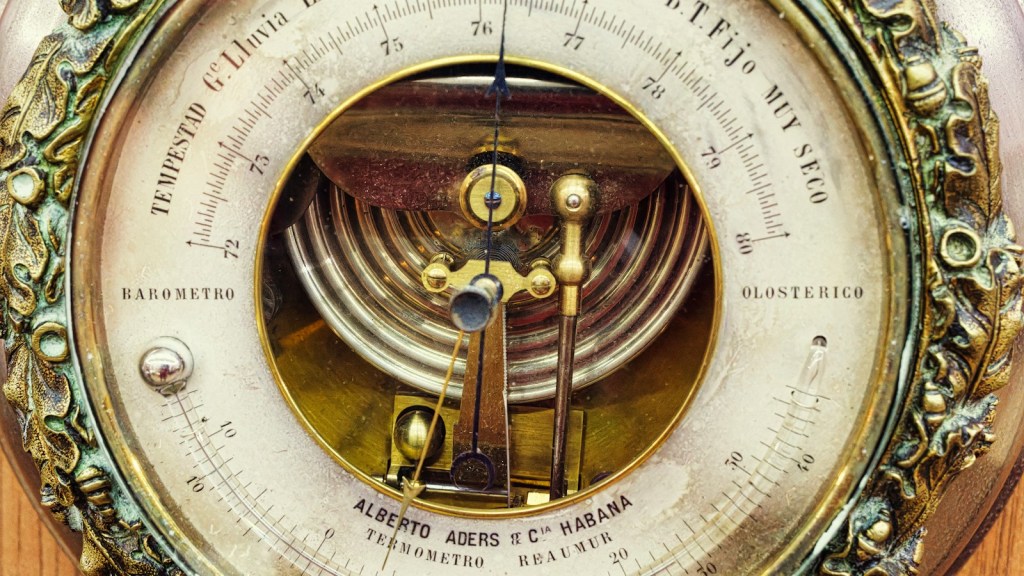
Instruments were improving. NASA credits Evangelista Torricelli with inventing the barometer in 1643, and Britannica places the invention in the mid-17th century. A barometer measures air pressure, and a falling reading signals lower pressure, which the Farmers’ Almanac notes lifts air and builds clouds.
The biggest change was the telegraph. Britannica reports that Samuel Morse developed the electric telegraph in 1837, which made rapid exchange of weather data possible. NASA says the telegraph enabled routine transmission of observations in the mid-19th century and allowed crude weather maps to be drawn. According to the National Weather Service’s heritage pages, Joseph Henry of the Smithsonian Institution persuaded telegraph companies in 1849 to send local weather data to the Smithsonian, and by 1857 stations from New York to New Orleans were sharing observations. Our article on how people communicated before phones explains why that speed mattered.
Governments soon built forecasting services. The Met Office says it was founded in 1854 under Robert FitzRoy, and after the Royal Charter Gale of October 1859 he developed a national storm warning service that began in February 1861. JSTOR Daily reports that the storm wrecked more than 200 ships and that FitzRoy began issuing forecasts in 1861.
In the United States, Cleveland Abbe of the Cincinnati Observatory began issuing regular forecasts from telegraphic data in 1869, according to Britannica and the heritage pages, which call his forecasts “probabilities.” On February 9, 1870, President Ulysses S. Grant signed a resolution authorizing a national weather service, as NOAA JetStream and the heritage pages report.
How did people predict the weather 100 years ago?
A century ago, forecasts were still made by people comparing observations rather than by computers. NASA describes synoptic forecasting, which compiled and analyzed observations taken at the same time over a wide area, as beginning in the 1860s, and it depended on skilled human judgment about how weather systems moved from one station to the next.
A bold new idea appeared in 1922. NASA reports that Lewis Fry Richardson published Weather Prediction by Numerical Process after producing a six-hour forecast by hand that proved inaccurate, and the Met Office says his work laid the groundwork for numerical weather prediction. The idea of calculating the weather from physics was sound, but it needed powerful computers that arrived decades later.
What changed when satellites arrived?
Both NASA and the National Environmental Satellite, Data, and Information Service report that TIROS-1, the first successful weather satellite, launched on April 1, 1960. For the first time, forecasters could see cloud formations developing across the globe rather than inferring them from scattered stations.
How accurate were old weather signs?
Some were surprisingly good in the right place, and others were not reliable at all. The red sky rhyme is useful where weather arrives from the west, according to the Met Office, and the Farmers’ Almanac calls it a rule of thumb rather than a guarantee. Theophrastus himself rarely explained his signs, and many are unreliable, according to the AOL account. The best use of weather lore was as one clue among several, which is how experienced sailors and farmers treated it.
What was left out, and why?
Several claims were left out because only one source supported them or the sources disagreed. These include a Babylonian effort to forecast from clouds around 650 BC, a stated accuracy rate for the Old Farmer’s Almanac, the claim that FitzRoy coined the word “forecast,” and the first forecasts appearing in The Times. The start date of the national weather service in the United States also differs between sources, 1870 for the authorizing resolution and 1871 for operations, so this article uses only the date on which both NOAA pages agree.
Frequently asked questions
How was weather predicted in the past?
People used weather lore, which is a body of sayings based on the sky, clouds, winds and animal behavior, and later almanacs, barometers and telegraphed reports from distant stations.
How did people predict the weather before technology?
They watched natural signs such as the color of sunrise and sunset, halos and the flight of birds, and they relied on rhymes passed from generation to generation.
How did people predict the weather in the 1800s?
They used almanacs and barometers, and from the mid-1800s the telegraph let forecasters share observations quickly, leading to the first national forecasting services.
How did people predict the weather 100 years ago?
Forecasters compared simultaneous observations from many stations on maps, and in 1922 Lewis Fry Richardson tried the first numerical forecast by hand.
How did people predict weather without technology?
By careful observation of the sky and the seasons, which worked best for short-term local forecasts where weather arrives from a consistent direction.
Reading the sky was once a survival skill for sailors and farmers alike. If you enjoy history and science explained clearly, subscribe to the channel Mr Global Rankss at https://www.youtube.com/@mrglobalrankss.
Related reading: How people navigated before GPS, how people communicated before phones, and how people stayed cool before air conditioning.
Sources
- NASA Earth Observatory: Weather Forecasting Through the Ages
- Encyclopaedia Britannica: History of weather forecasting
- Library of Congress: Red sky at night, sailor’s delight
- Met Office: Red sky at night
- Farmers’ Almanac: Red sky at night
- LacusCurtius: Theophrastus, On Weather Signs
- AOL: The Greek philosopher who was perhaps the first weather forecaster
- Encyclopaedia Britannica: Farmers’ Almanac
- The Old Farmer’s Almanac: History
- Met Office: Robert FitzRoy and the early Met Office
- Met Office: Our history
- JSTOR Daily: Robert FitzRoy and the laws of storms
- NOAA National Weather Service heritage: Crossroads in weather history, the pioneers
- NOAA JetStream: Introduction to the National Weather Service
- NOAA NESDIS: Celebrating the world’s first weather satellite


Leave a Reply