
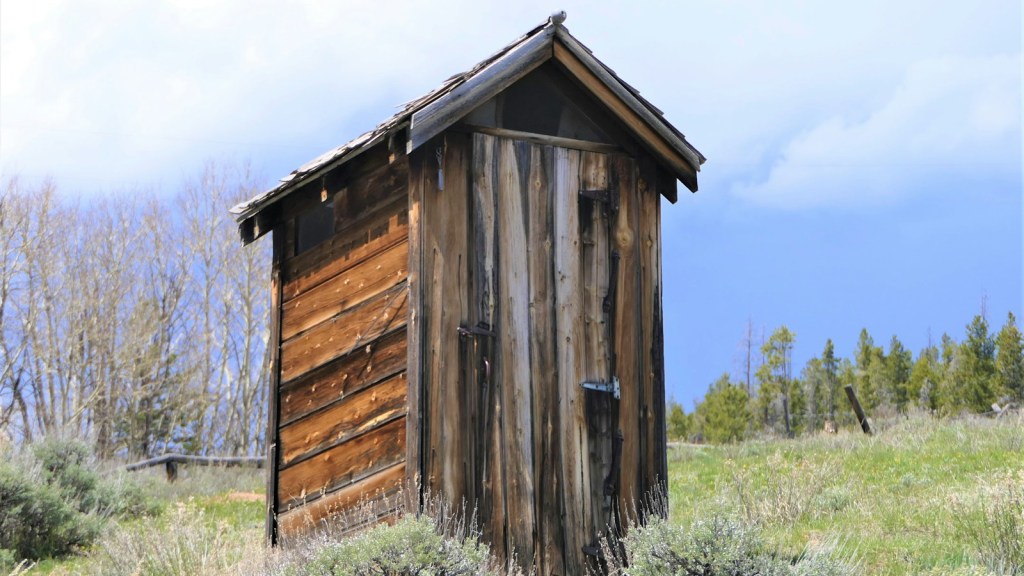
How did people use the bathroom in the 1800s? For most households, the answer was a chamber pot indoors, especially at night, and a privy, often called an outhouse, in the yard. Flush toilets existed from the late 1700s, but they remained a luxury for most of the century, and the typical 1800s bathroom was not a room at all. This article follows the century from chamber pots and backyard privies to the first hotel water closets, London’s Great Stink and the slow arrival of indoor plumbing in the 1800s, drawing on the Science Museum and Brownstoner. For the longer story that begins before the 1800s, see our guide to how people used the bathroom before toilets.
What was an 1800s bathroom actually like?
In the early 1800s, many city houses simply had no bathroom. Brownstoner describes houses in Brooklyn Heights and Greenwich Village from this period with a tub stored in the pantry, a chamber pot under each bed and a privy out back. The washing of hands and face took place at a basin in the bedroom or kitchen, and a full bath was an occasional event. You can read more in our article on how people in the 1800s bathed.
The dedicated room we now take for granted arrived gradually. By the late 1870s, according to the same Brownstoner history, single-family row houses in Brooklyn were being built with dressing rooms that had hot and cold water, which mattered because many homes had only one. A true Victorian bathroom, with a fixed tub, a basin and a water closet under one roof, belonged largely to the end of the century and to households that could pay for it.
What was a chamber pot, and how was it used?
A chamber pot was a portable ceramic vessel kept in the bedroom. The Science Museum notes that chamber pots and cesspits were the most common ways of containing waste until the late 1800s, and that wealthy households sometimes owned elaborately decorated examples, including a glazed earthenware pot inscribed with poems.
The pot was especially useful after dark and in winter. 6sqft explains that New Yorkers kept earthenware pots under their beds for night use, and that the pots then had to be carried down to the backyard outhouse to be emptied.
What was a privy, and how did an outhouse work?
A privy was a small outbuilding placed over a pit, and in the United States it was commonly called an outhouse. The Atlas Obscura account of 19th-century U.S. city sanitation describes privies as deep holes in the ground of limited capacity that had to be cleaned out regularly.
Privies also left a record for later generations. The New York City Archaeological Repository records a privy used from the late 1700s to the middle of the 1800s whose layers show it was cleaned out by hand during its working life, and Heritage Ohio describes how excavated privies yielded a wide array of everyday artifacts that reveal how former residents lived.
Who emptied the waste, and where did it go?
Removal was a trade. In both countries the work was done at night by men known as night soil collectors. WDYTYA Magazine reports that in Britain these night soil men reportedly earned 23 shillings a week, while in the United States, according to Atlas Obscura, thousands of night soil carts moved through cities each year, with the work done largely by Black and immigrant men.
The destination was often a waterway. Both Atlas Obscura and 6sqft report that much of New York’s waste was dumped into the East and Hudson Rivers, although some was used as fertilizer. In tenements, 6sqft adds, residents shared a small number of backyard outhouses, which made them a significant source of disease.
When did flush toilets appear, and who could afford one?
The key invention came in 1775, when the Scottish watchmaker Alexander Cumming received the first British patent for a flushing water closet. His S-shaped trap held water in the pipe and blocked odors from returning, as the National Archives explains. Joseph Bramah patented an improved design in 1778, and the Science Museum notes that it remained one of the leading designs for the next century.
In the United States, the Tremont House in Boston, which opened on October 16, 1829, is often described as the first hotel with indoor plumbing. Wikipedia and Brownstoner both record eight water closets on its ground floor, supplied by water from a roof tank. For the later story of the presidential residence, see when the White House got flush toilets.
Public provision followed in Britain. At the Great Exhibition of 1851, George Jennings installed paid flush toilets that charged one penny, a fee that the National Archives and WDYTYA Magazine both connect to the phrase “to spend a penny.” Roughly 800,000 visitors used them during the exhibition. Jennings also patented a water closet in 1852 with the pan and trap formed in one piece, the basis of most later toilets.
Did Thomas Crapper invent the flush toilet?
No. The Smithsonian Magazine states plainly that Crapper did not invent the flush toilet or hold its patent, and the Science Museum says the same. Crapper was a real and successful London sanitary engineer, and WDYTYA Magazine dates his Chelsea showroom to 1870, where customers could see fixtures on display.
His fame owes more to showmanship than to invention. The credit for the S-trap belongs to Cumming in 1775 and for the early valve designs to Bramah and others, while Crapper helped to bring such fittings to a wider public.
Why was the Great Stink such a turning point?
Flush toilets solved a problem inside the house and created one outside it. The London Museum explains that as water closets became popular, wealthier households sent waste directly into the river, and the Thames carried it past the capital. In the summer of 1858, with temperatures above 86 F (30 C) and a shrunken river, the smell became unbearable. History Extra reports a high of 95 F (35 C) on June 16 and notes that the blinds at the Palace of Westminster were soaked in chloride of lime.
Action followed quickly. According to the London Museum, Benjamin Disraeli’s bill to fund a new sewer became law in 18 days. Joseph Bazalgette’s system was built from 1859 and finished in 1875, and the Science Museum calls it the foundation of London’s sewers today.
How did the experience differ for the rich, the poor and the countryside?
Wealth and location decided almost everything. WDYTYA Magazine reports that indoor toilets were common among the middle class but rare in working-class homes, with terraced houses often keeping outdoor toilets well into the 1900s. The National Archives adds that although sewers arrived in the second half of the century, earth closets remained more common for over a century.
The earth closet was a Victorian alternative to the flush toilet. Reverend Henry Moule, who was moved to act by the cholera epidemics of 1849 and 1854, patented his dry earth system in 1860 with James Bannehr, according to both Grace’s Guide and Wikipedia. It was used in private houses, rural districts, camps and hospitals. In the United States, Brownstoner notes that tenement residents often relied on outdoor privies or a shared toilet on each floor, and 6sqft reports that the 1901 Tenement Law finally required a separate water closet in each new tenement apartment.
What did people use instead of toilet paper?
Commercial toilet paper was a novelty. Joseph Gayetty, a New York entrepreneur, sold medicated sheets of manila hemp paper from 1857, treated with aloe and promoted as a remedy for hemorrhoids, as both Mental Floss and Wikipedia record. Each sheet carried his name, and the product was far from universal.
What does this history show?
The 1800s were a century of transition. Flush technology existed from 1775, yet the privy, the chamber pot and the night soil cart remained ordinary parts of life for most people. What changed the picture was not the toilet itself but the infrastructure around it, namely water supply, sewers and public health law. Cities that skipped that step, as London discovered in 1858, simply moved their problem into the river.
What was left out, and why?
Several popular claims were omitted because only one reliable source supported them or the sources disagreed. These include the exact introduction date of the Unitas one-piece toilet (1883 or 1884 depending on the source), the claim that Albert Giblin invented the siphonic flush, specific casualty figures for New York cholera outbreaks, the date of the Astor House bathrooms, and the Scott brothers’ roll paper. Details of Crapper’s patents and of what people wiped with before commercial paper were also left out for the same reason.
Frequently asked questions
How did people use the bathroom in the 1800s?
Most used a chamber pot indoors and a backyard privy or outhouse, while wealthier households increasingly had water closets by the later decades.
Did people in the 1800s have flush toilets?
Some did, because the first British patent dates to 1775, but they were rare for most of the century and common mainly among the well-off.
What was night soil?
Night soil was the polite term for human waste emptied from privies and cesspits, usually by workers who removed it after dark.
What was the Great Stink?
It was the summer of 1858, when heat and a low Thames made London’s polluted river unbearable and pushed Parliament to fund Bazalgette’s sewers.
If you enjoy history like this, browse more in our History and Facts sections and subscribe to Mr Global Rankss on YouTube (https://www.youtube.com/@mrglobalrankss) for more science, history and rankings.
Related reading: How Did People Use the Bathroom Before Toilets? | How Did People in the 1800s Bathe? | When Did the White House Get Flush Toilets?
Sources
- Science Museum: A flushing story
- Smithsonian Magazine: Three true things about Thomas Crapper
- Wikipedia: Tremont House (Boston)
- London Museum: The Great Stink of 1858
- History Extra: The Great Stink, London's unbearable summer of 1858
- The National Archives: Toilet design
- Mental Floss: Toilet paper history
- Wikipedia: Joseph Gayetty
- Atlas Obscura: When cities were full of waste
- Brownstoner: A quick history of the bathroom
- 6sqft: Life in New York City before indoor toilets
- WDYTYA Magazine: The remarkable history of toilets
- Grace's Guide: Henry Moule
- Wikipedia: Dry toilet
- Wikipedia: Flush toilets at the Great Exhibition
- Heritage Ohio: Tales from a privy shaft
- NYC Archaeological Repository: Stadt Huys Block privy deposit


Leave a Reply